-->

Welcome

I love answering your questions. If you ask them in the comment section, I have no way to answer you (if you haven't heard from me, that is why). If you use the "EMAIL ME" in the left column of this page, I will be able to respond to you. You can also use it if you want to be added to my newsletter. Laura

Saturday, February 26, 2011

Tutorial – How to Make Your Own Molds and Molding With Paper Clay

This altered cabinet card is titled “In the Land of the Butterfly Queen”.  The garden face at the bottom of the card is made of paper clay.
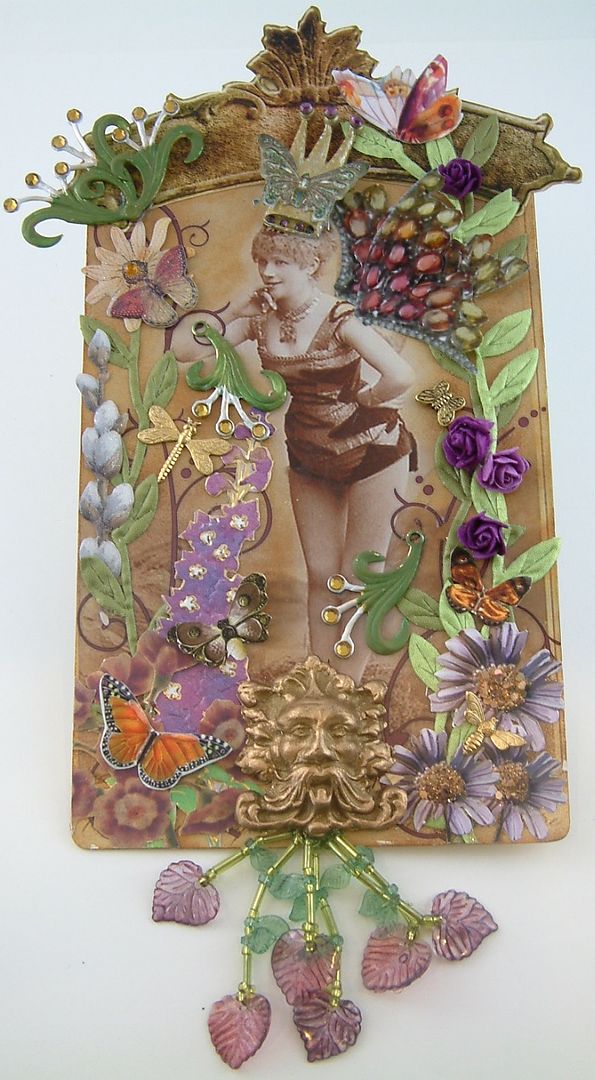
To save money I often purchase an interesting but expensive piece that I can use to make into a mold, I then create as many pieces as needed.  I’ve also made molds of decorative objects in my house.  After I create the mold I typically use paper clay to mold the piece.  This is because paper clay does not require baking (air dries), can be painted, is easy to trim, is light weight and fairly durable. 

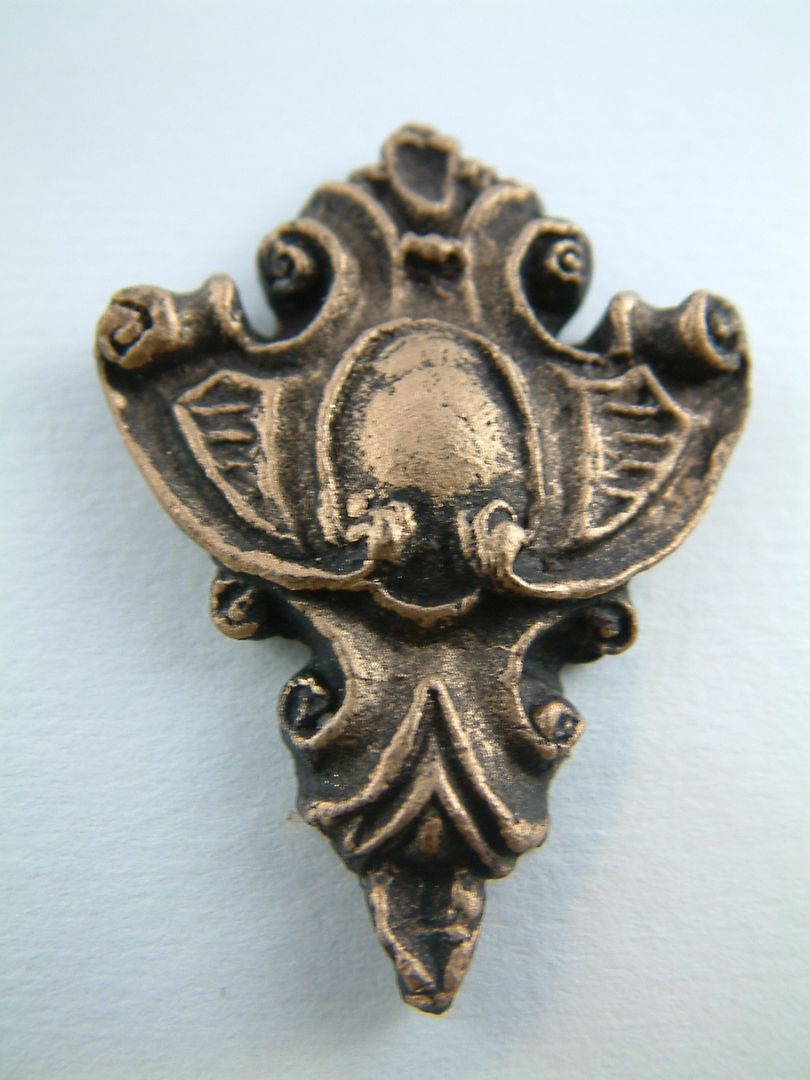
Below you can see the stages of the garden face from brass piece to finished painted paper clay piece.

This tutorial walks you through the steps of making a mold and then molding items using paper clay.  You can make a mold from metal or plastic objects and from rubber stamps.  The mold you make can be used with a variety of materials including UTEE, wax, soap, and air clay or clay requiring baking.  The mold can stand up to the heat of materials such as melted wax.  For the purposes of this tutorial I’m going to focus on using the paper clay with the mold because for me it is the most common use molds and it doesn’t require the use of a melting pot or oven.
What You Will Need
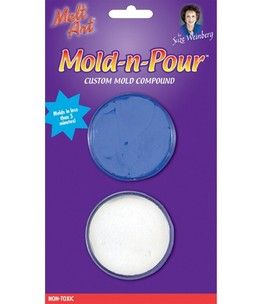
Mold-n-Pour – In the US you can find this at both Michaels and JoAnn craft stores.  Other crafts stores may also carry it.  On-line you can purchase it from Amazon.com, Createforless.com, Overstock.com and a huge variety of other on-line stores.
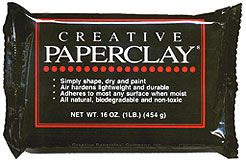
Creative Paper Clay – You can find this product in pretty much the same places as the Mold-n-Pour.
I recommend reading through the entire tutorial before starting
Making a Mold from a Metal or Plastic Object
Step One – Selecting an Object to Mold
To make it cost effective, I try to choose objects that I think I will want to repeatedly mold.  You’ll want to select a dimensional object and one that does not have too much detail with too many holes.  It is difficult to get a good mold if there are lots of holes and once you mold the piece it is hard to clean it up.
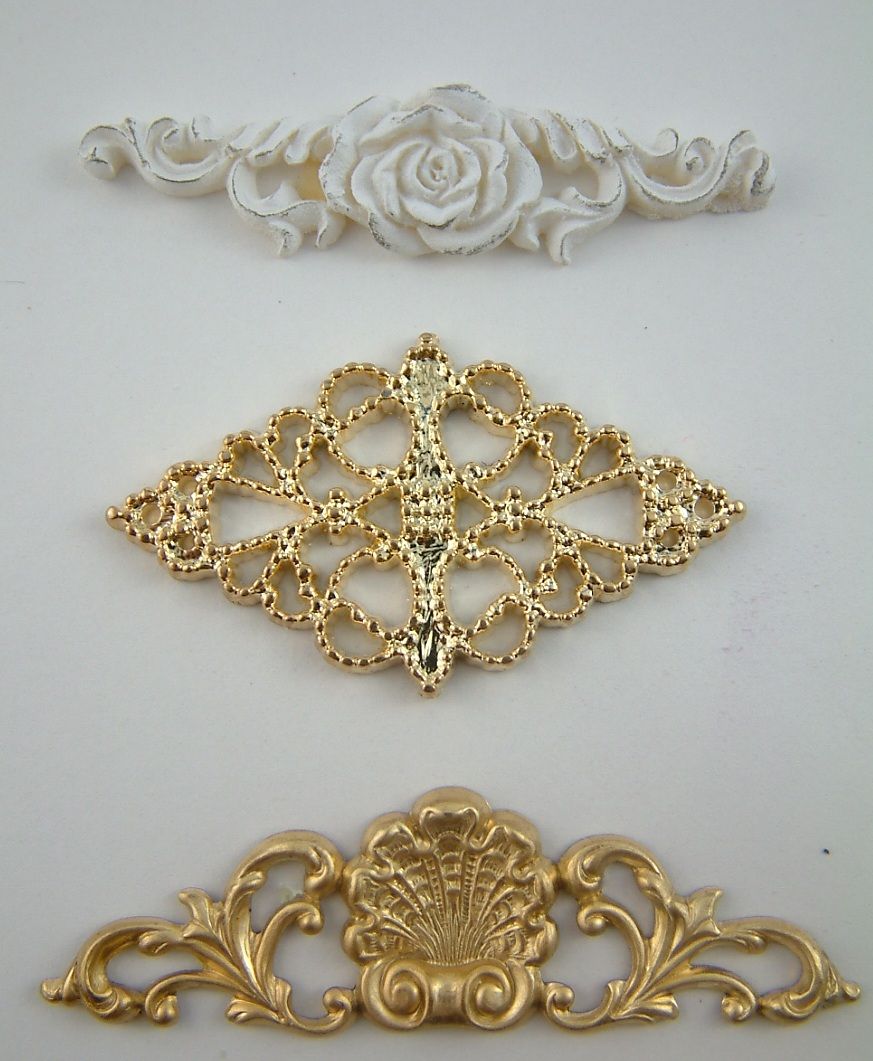
The objects below are bad choices as there are lots of holes and detail.
Here are a few good examples of objects I’ve molded.
Architectural details make good molds.  In the card below I used the top and bottom of one column and the top of the other.  Using paper clay made it easy to cut the columns in half so I could use both ends.
I molded a resin flourish to create a wing.
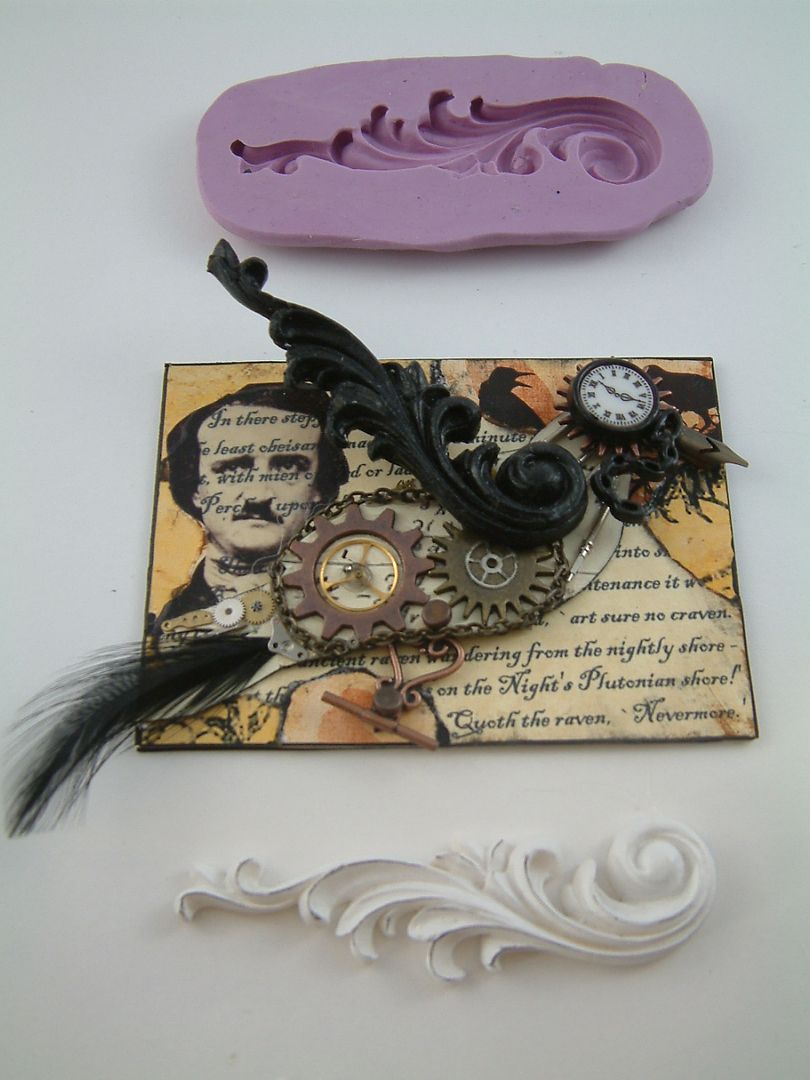
I made a mold of a plastic fleur de lyse that you see on the glass slide card below.
Step Two - Prepping the Molding Material
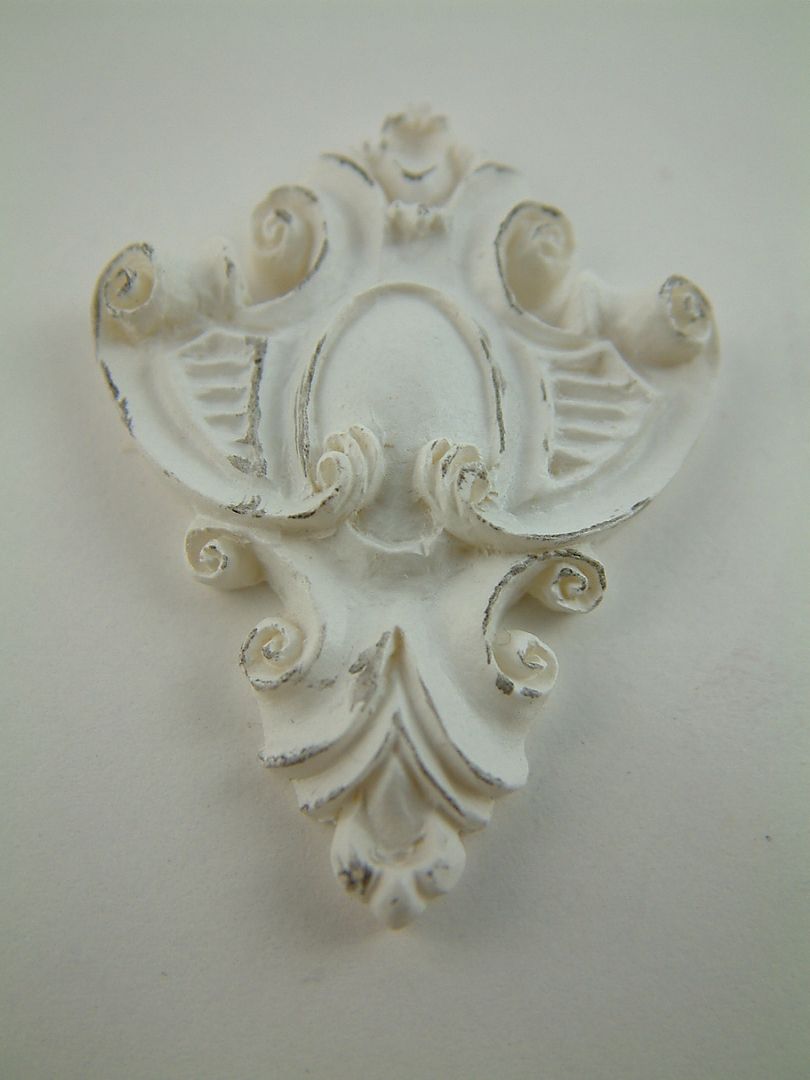
In this tutorial I’ll be creating a mold of the resin piece in the picture below.
Combining the materials from the two containers causes the mold to set.  Don’t mix the materials until you are ready.  Depending on the dampness of your climate you only have about 5-10 min before the mixture hardens.  Only use the amount of material you need.  The material in one container will be white and the other will be purple or blue (I think they recently changed the color from purple to blue).  For the purpose of this tutorial I’ll start with the colored material.
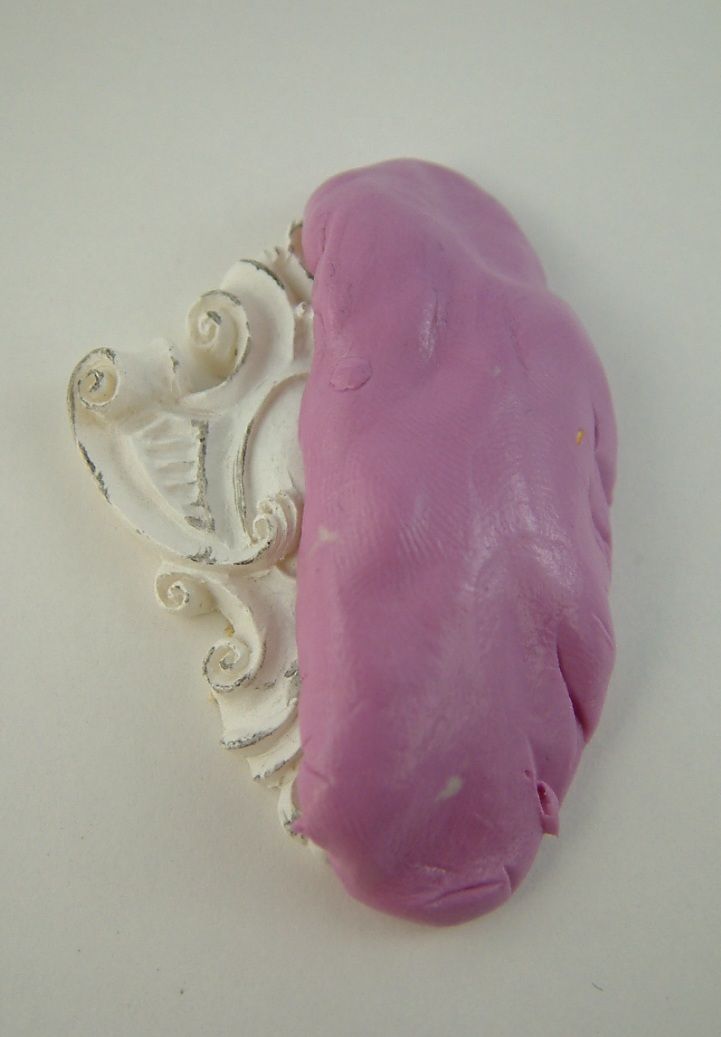
Remove enough blue or purple material from the container to cover a little more than half of your object.  You can stretch the material over the object to determine if you have enough. In the picture below, note how there is enough material to cover a little more than half of the object.
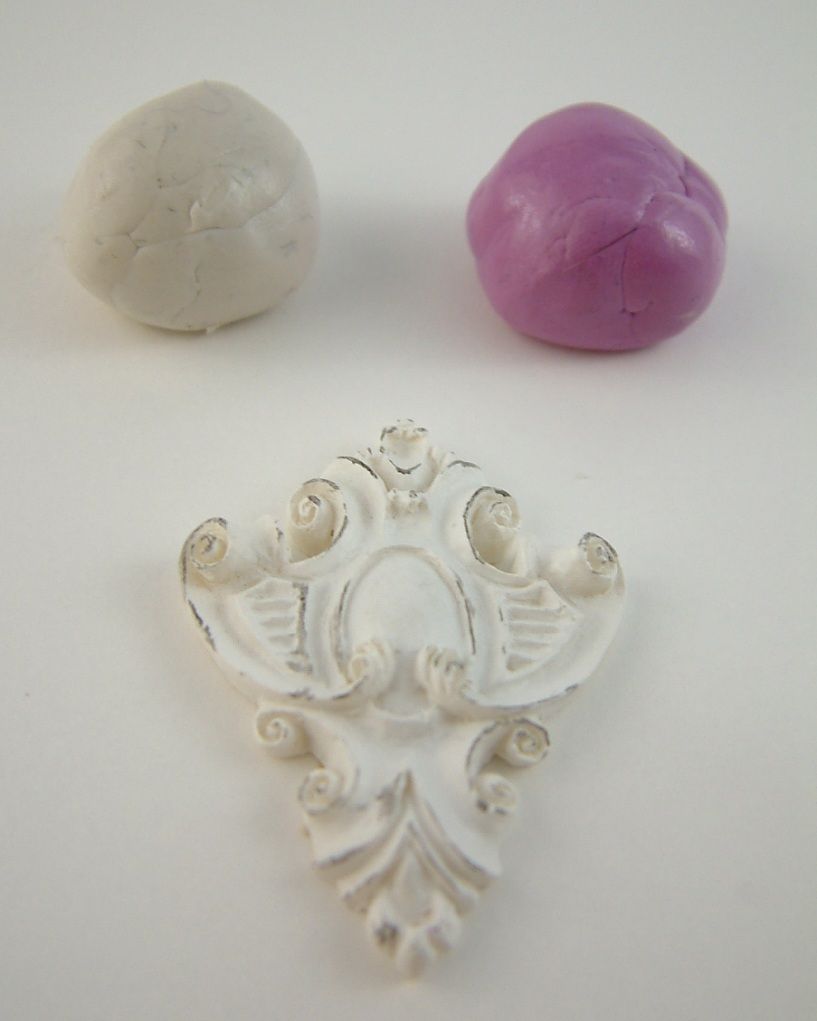
Once you think you have the right amount of material, roll it into a ball.  Remove the same amount of white material from the other container and roll it into a ball.  Adjust the amount of white material until the balls are equal in size.  See below.
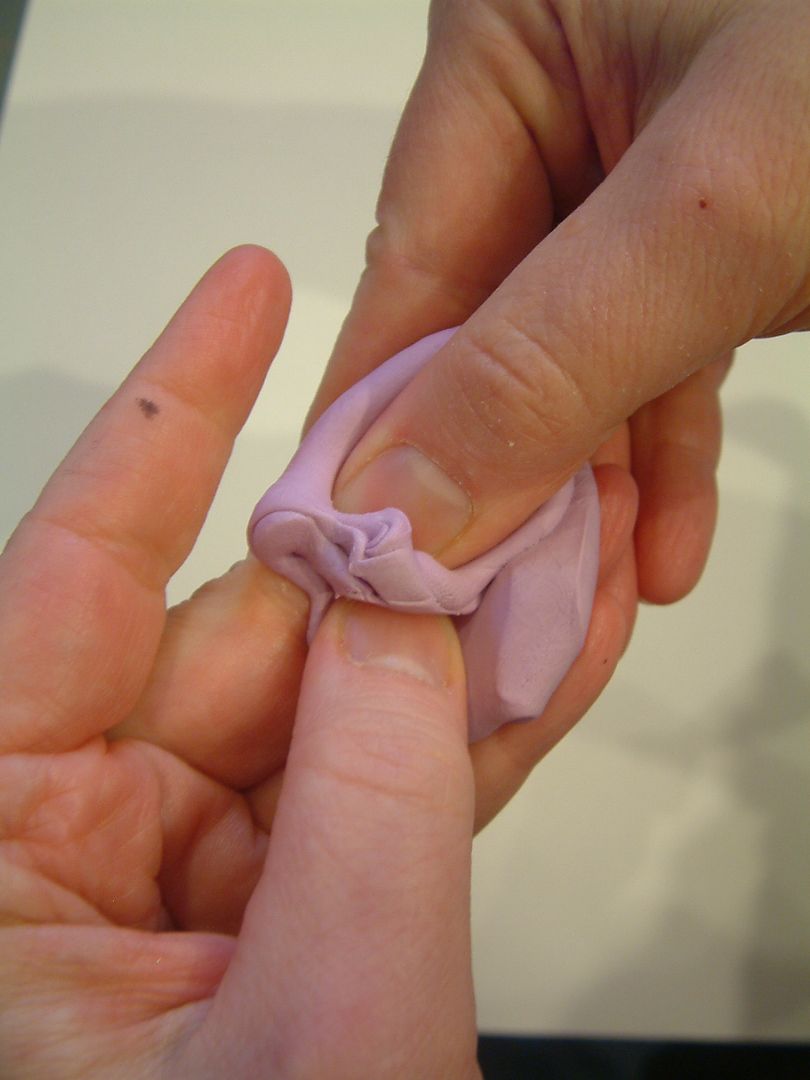
Begin mixing the balls together, quickly kneading and blending them into a single color.  Remember once you begin combining the materials, you only have about 5 – 10 minutes before the mixture sets.  Knead the material with the tips of your fingers as the heat from your palms makes the molding material set more quickly.
Step Three - Molding Your Selected Object
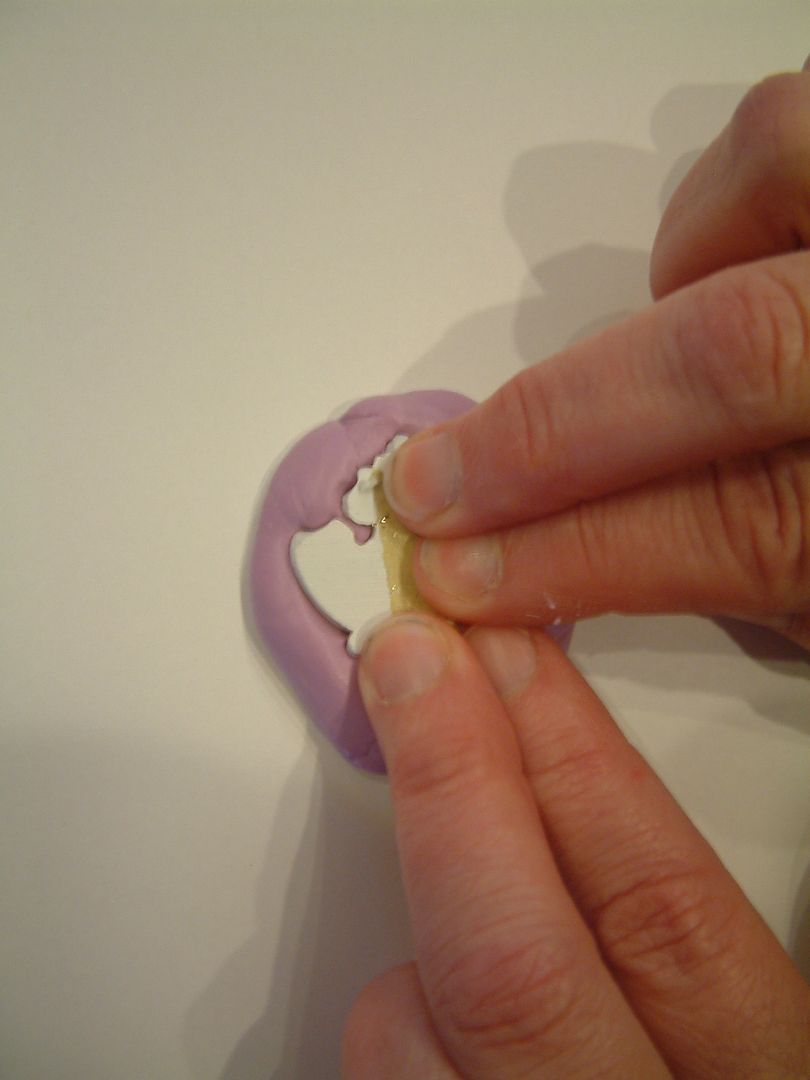
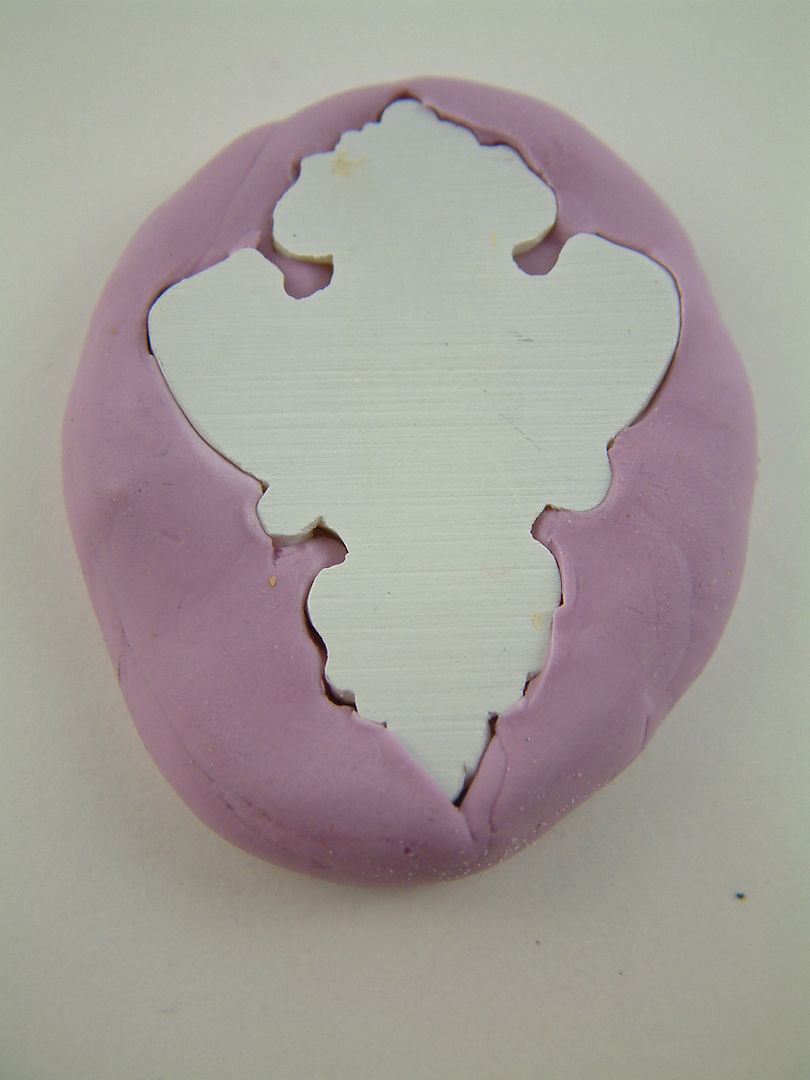
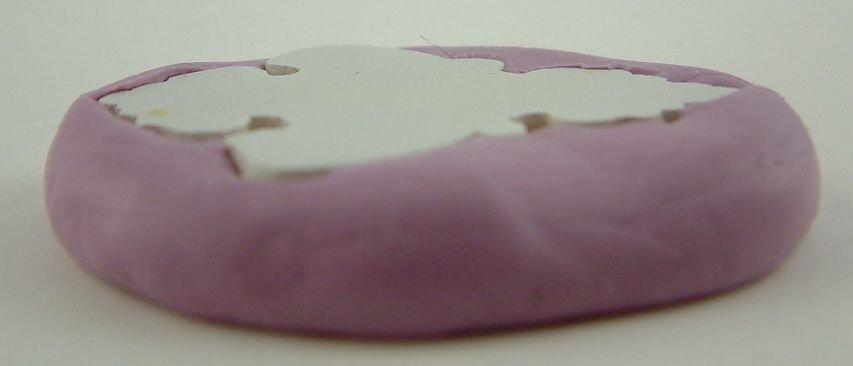
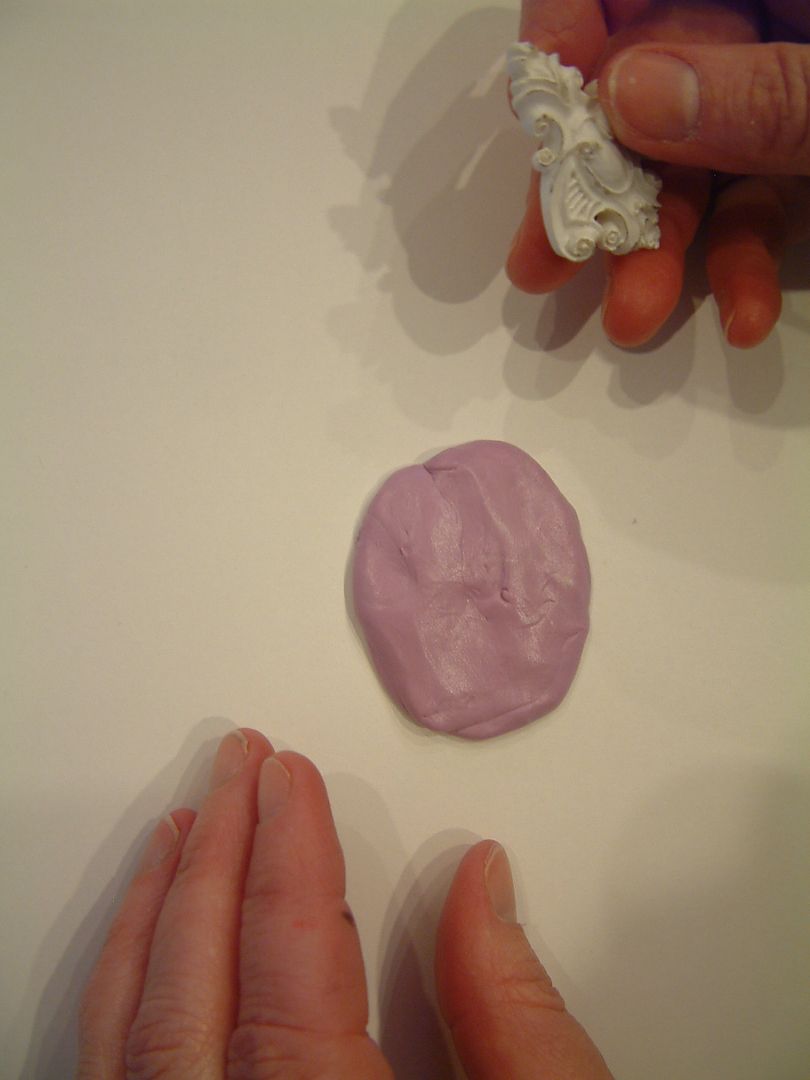
Flatten out your mixed molding material so that it is slightly larger than your object and press your object into the material.  Be careful not press the object completely though the molding material.  The material should be flush with the sides of the object.  You may need to press and adjust the molding material to get it properly around the object.
Step Four – Drying
Leave your object in the molding material for about 10 minutes then remove.  The mold should be set and ready to use.
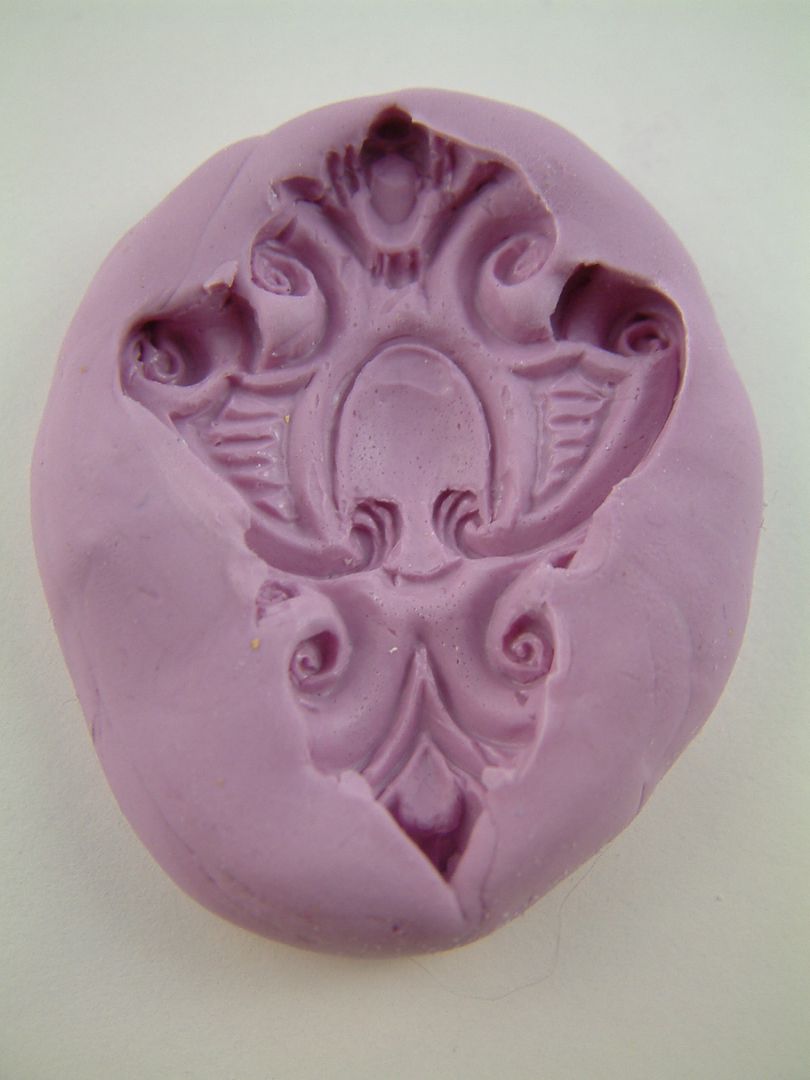
Molding with Paper Clay
Step One – Pressing Clay into the Mold
Paper clay is very easy to work with.  Remove the amount you think you will need to fill the mold.  Knead the clay together so that the texture is consistent.  Press the clay into the mold.  You want the mold to be filled and the clay to be flush with the top of the mold.  Remove any excess clay.
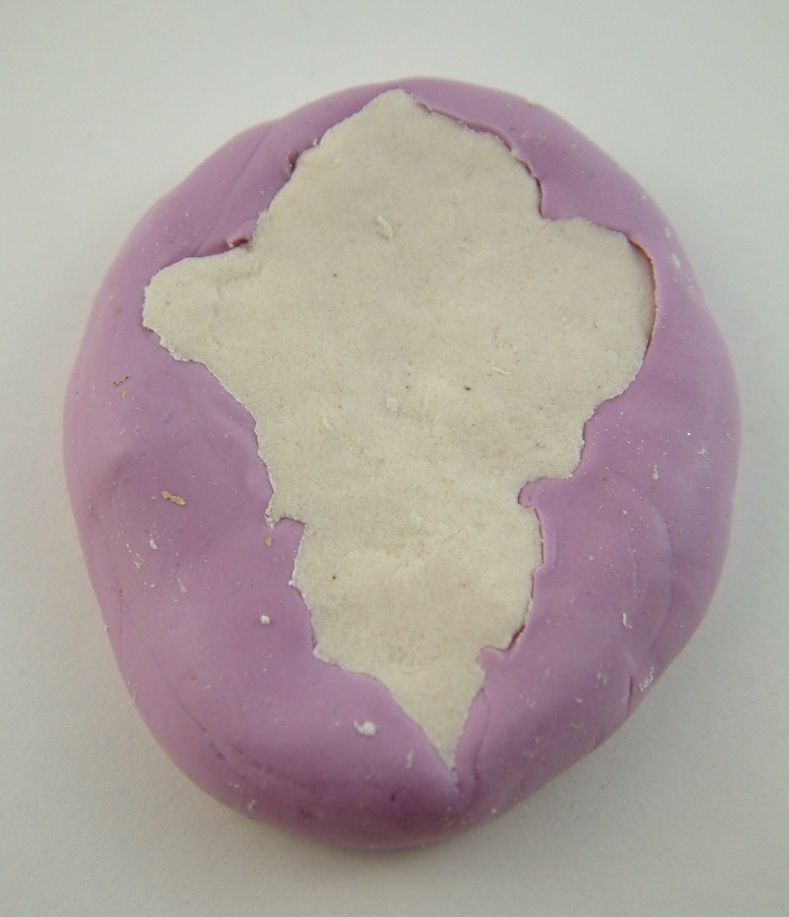
Step Two – Removing the Molded Clay
Leave the clay in the mold to dry for about an hour.  In this allows the clay to dry just slightly which makes it easier to remove without damaging the design.  Carefully remove the molded clay and place it on a paper towel.  The towel helps draw the moisture out of the clay.
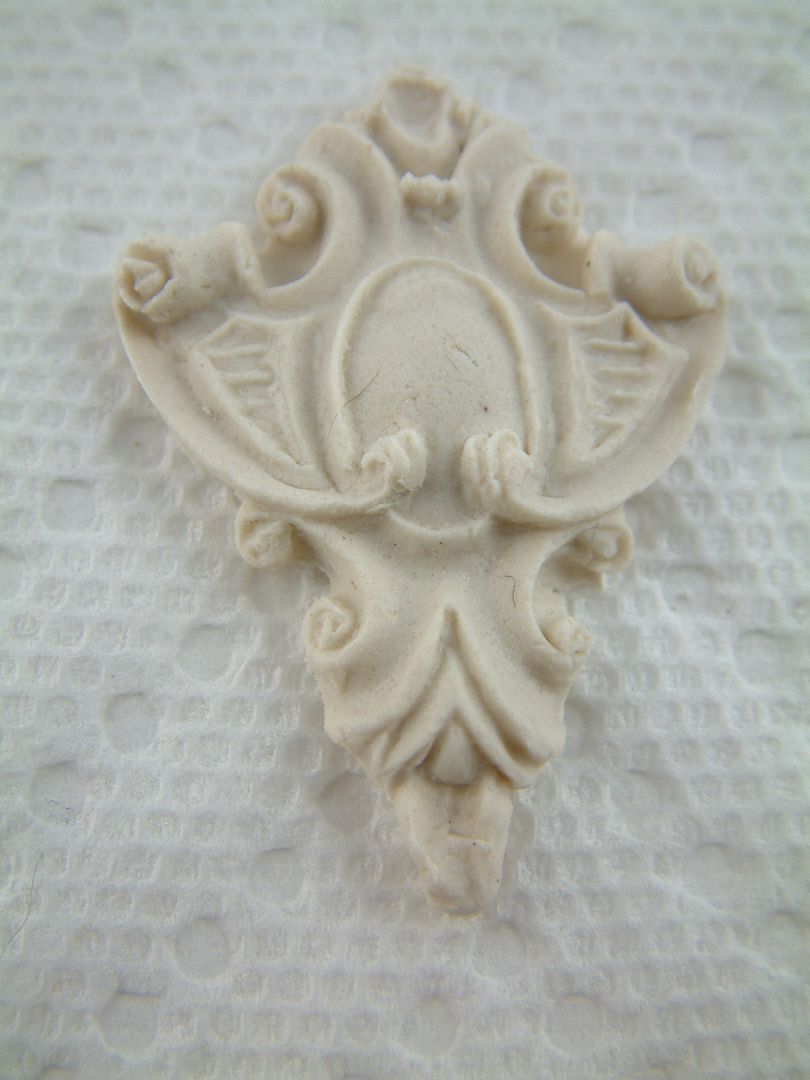
Step Three - Drying the Clay
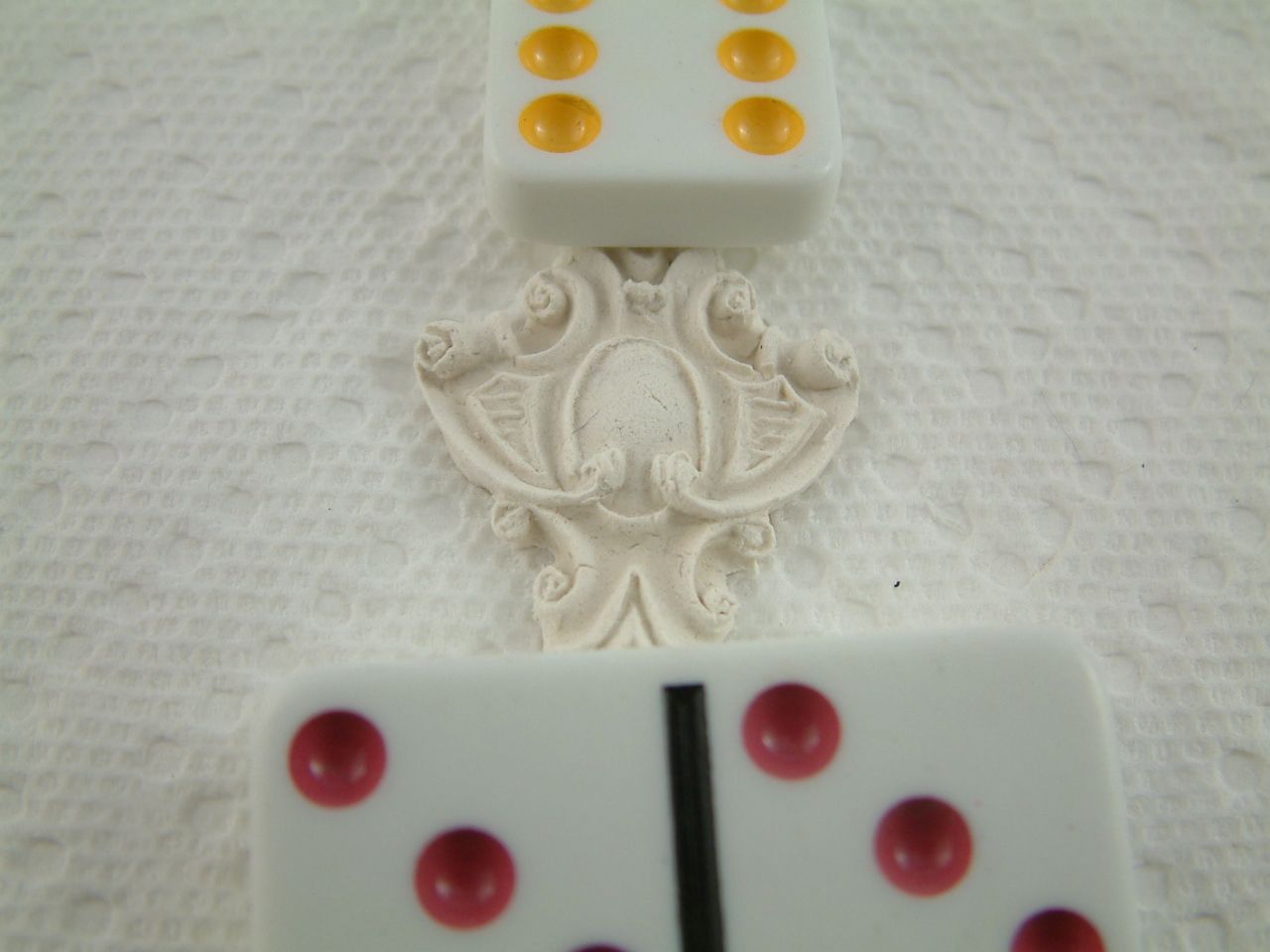
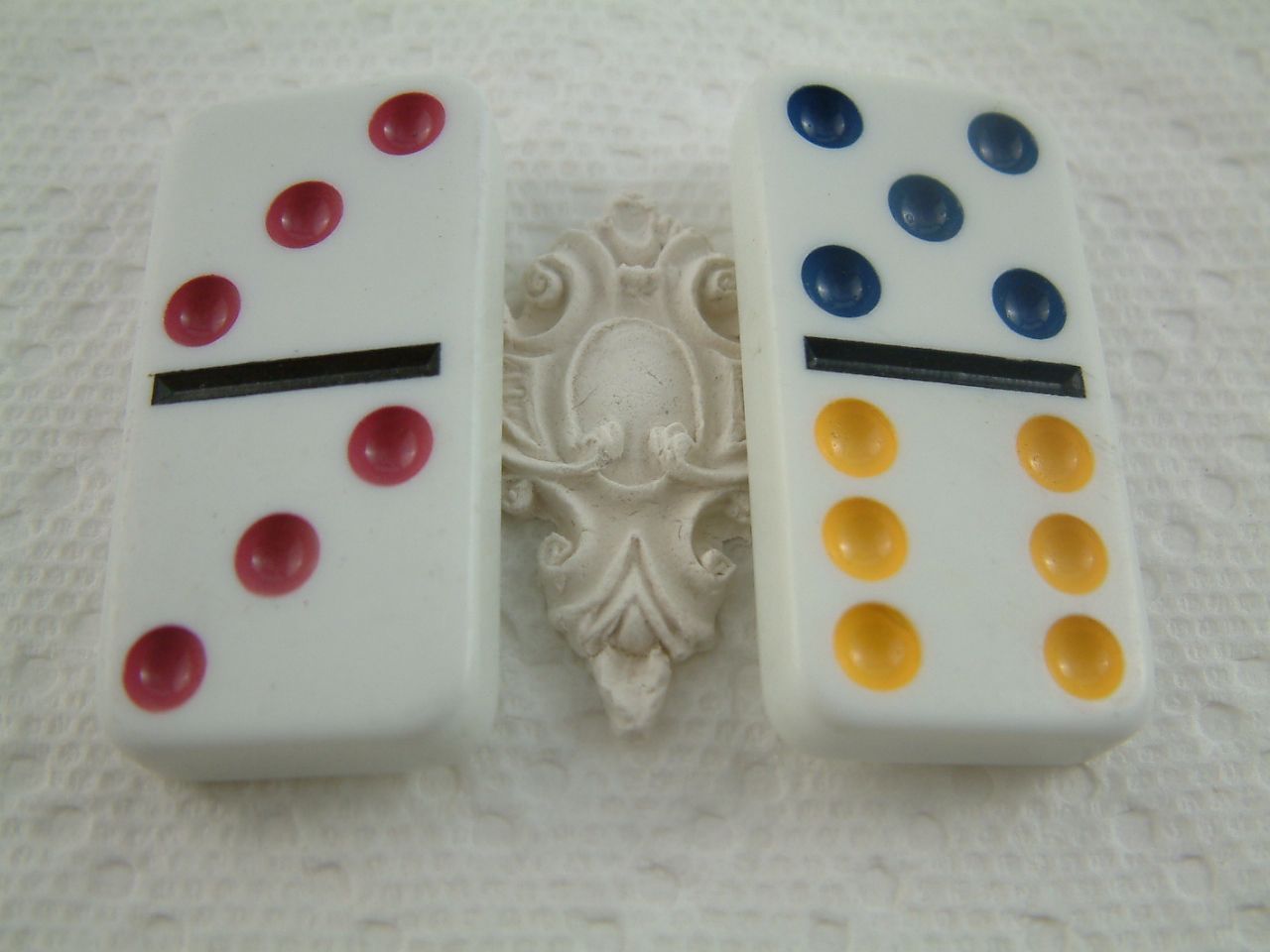
Paper clay takes a long time to dry and the drying time will vary with the dampness of your climate.  It could take as long as a day for it to get completely dry.  During the drying process you should occasional move the molded clay to a different spot on the paper towel.  Paper clay likes to curl as it dries so once the outer surface is just a little dry apply some weight to the molded clay to prevent curling.  You can see below I placed dominos on the edges of the molded clay to add pressure.  As the clay dries it will turn from an off white color to white and become rigid.  The clay may seem dry on the surface but it may still be wet in the middle.
Step Four – Trimming
You may need to trim or cleanup your dry molded clay piece.  You can trim up your molded piece with scissors, sandpaper, or precision filing tools.  Here is the link for information on precision filing tools http://artfullymusing.blogspot.com/2010/11/cool-tool-precision-file-set.html
You are now ready to decorate your molded piece.
Making a Mold from a Rubber Stamp
The steps for making a mold from a rubber stamp are exactly the same as for a metal or plastic object.  The only difference is to make sure that you have enough molding material than when mixed, covers the raised part of the rubber stamp.  Instead of pressing an object into the molding material press the rubber stamp into the molding material.  Leave the rubber stamp in place for 10 minutes and remove when the mold is set.  When choosing a rubber stamp, too much fine detail does not make a good mold.  For this card titled “Le Jardin” I wanted to create a topiary, so I made a mold from a garden urn rubber stamp.
Storing Paper Clay
To keep your paper clay moist, seal the package in a plastic bag.  Next, place the plastic bag in another plastic bag.  Drip some water into the second bag and seal it.  Because you sealed the clay in the first bag the water won’t come in touch with the clay but will evaporate in the second bag and keep the air moist around the first bag.  And as you know, no bag is completely airtight.  If you don’t do this your clay will dry out.  This is also a great trick for keeping brown sugar moist. 

Saturday, February 19, 2011

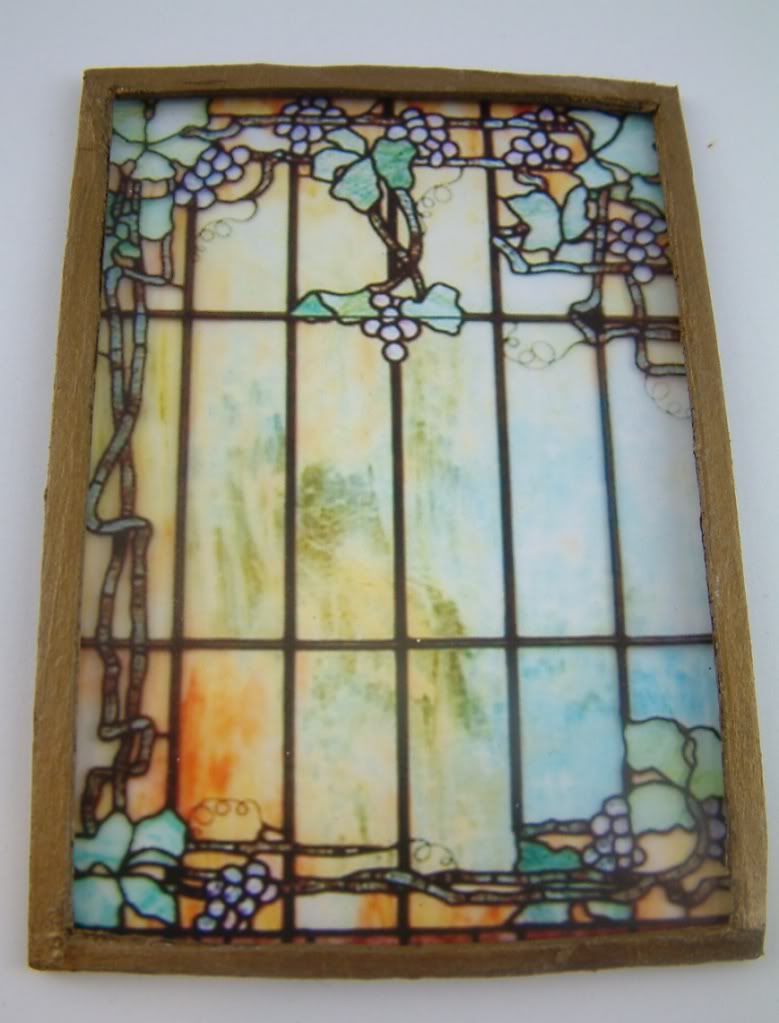
Art Nouveau Inspired Glass Piece

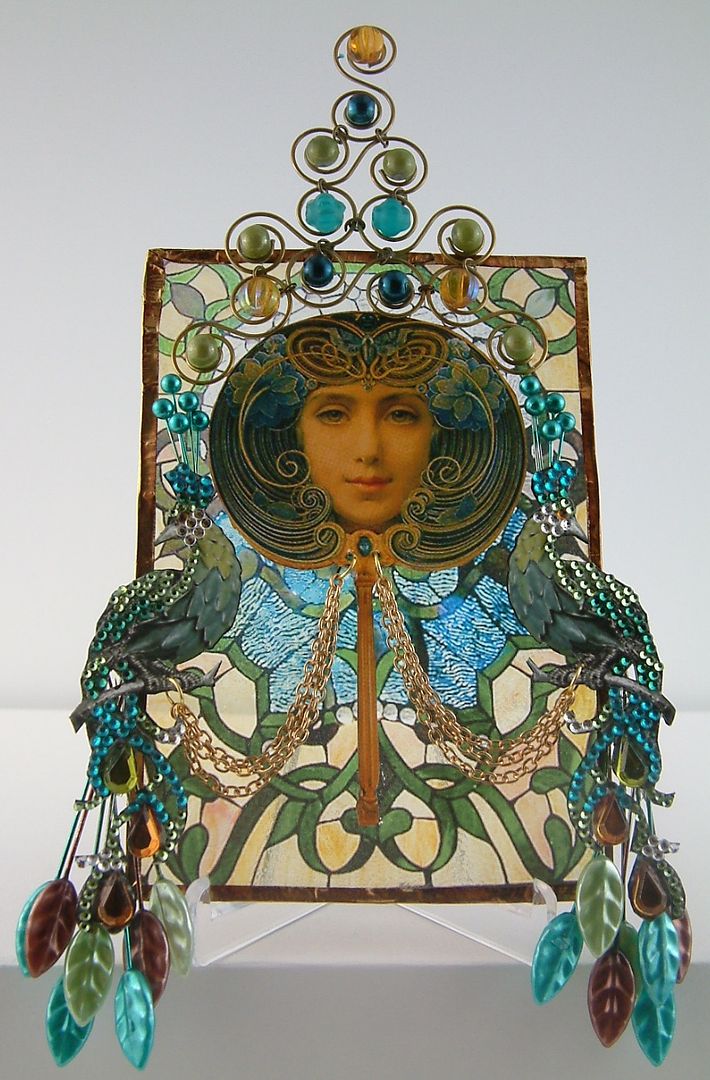
I purchased some frames to frame some of my art.  Since my art is three dimensional I didn’t need the glass so I decided use it as a base (its 3 ½ “ x 5”).  I wanted to use an embossing technique on the glass but I didn’t have a rubber stamp to fit the art nouveau theme.  But I did have a digital image.  So I decided to print the image on transparency film, emboss the image and glue it to the glass.  Click here if you want to see the tutorial on how to emboss transparency film.  I used Glossy Accents to glue the transparency to the glass as it dries clear.  I painted the glass with a thin coat of the glue then applied the transparency.  I used foil tape to cover the edges.  The tape was gold, but I wanted more of a copper color so I painted the tape with alcohol ink before applying it to the glass.  When I finished it looked exactly like a piece of stain glass.  You cannot tell that there is a piece of transparency film glued to the glass.
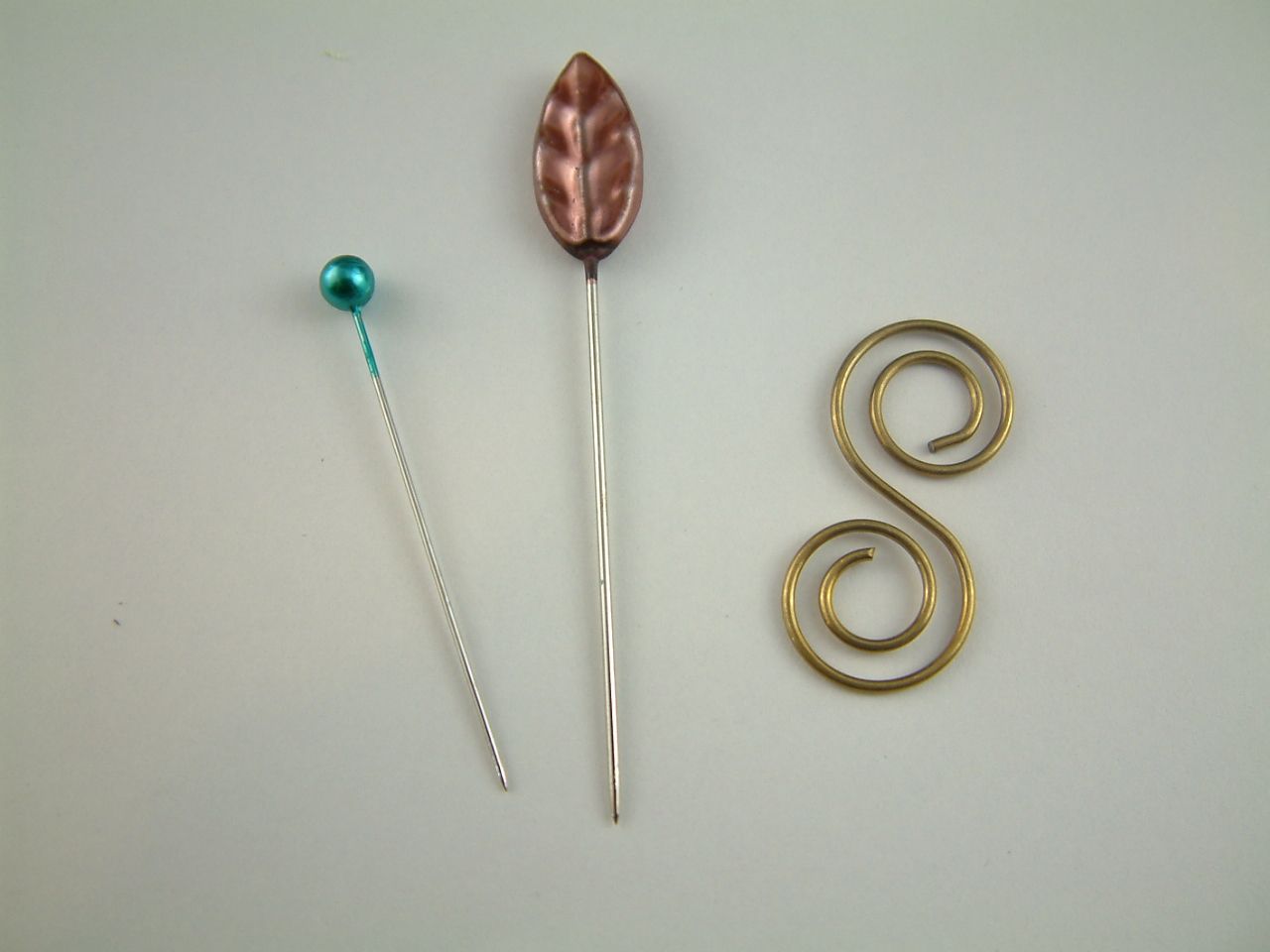
The peacock tail and head feathers are made of straight pins.  I painted the metal shafts with alcohol inks.  The headdress is made from spiral paperclips.

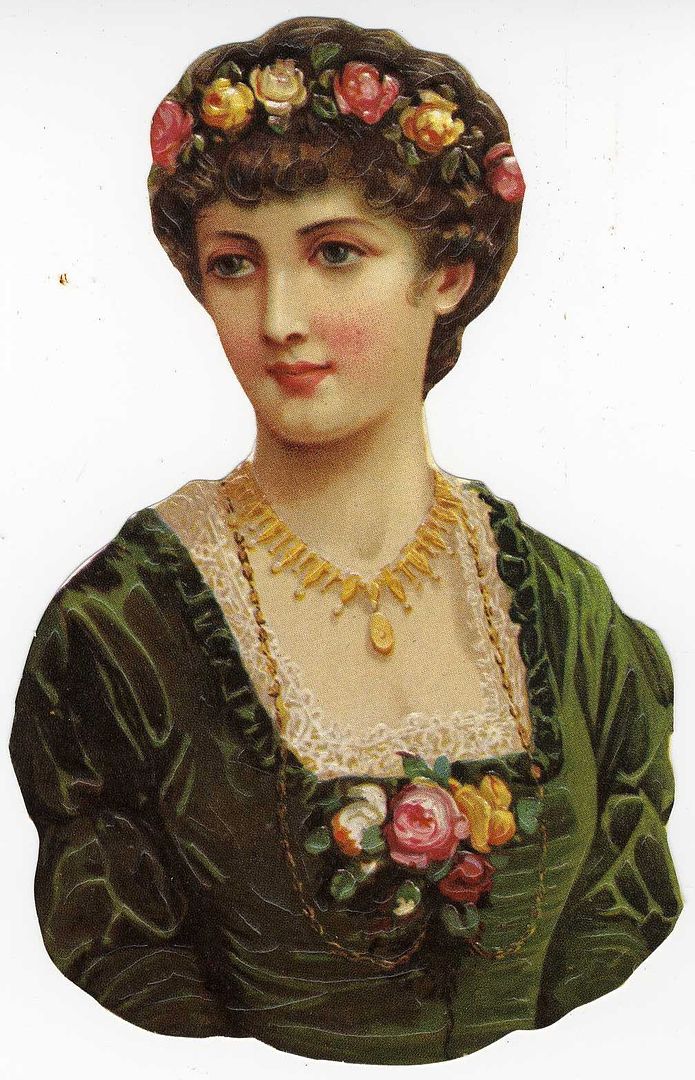
Vintage Victorian Scrap - First Set

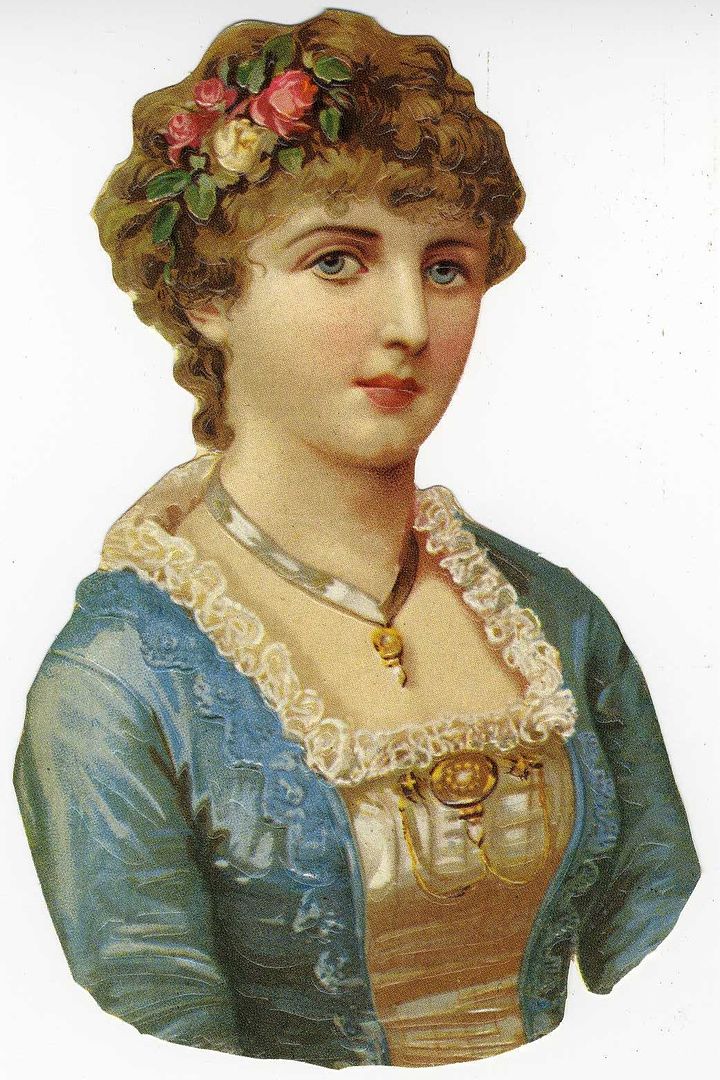
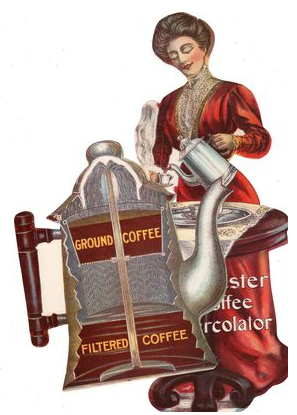
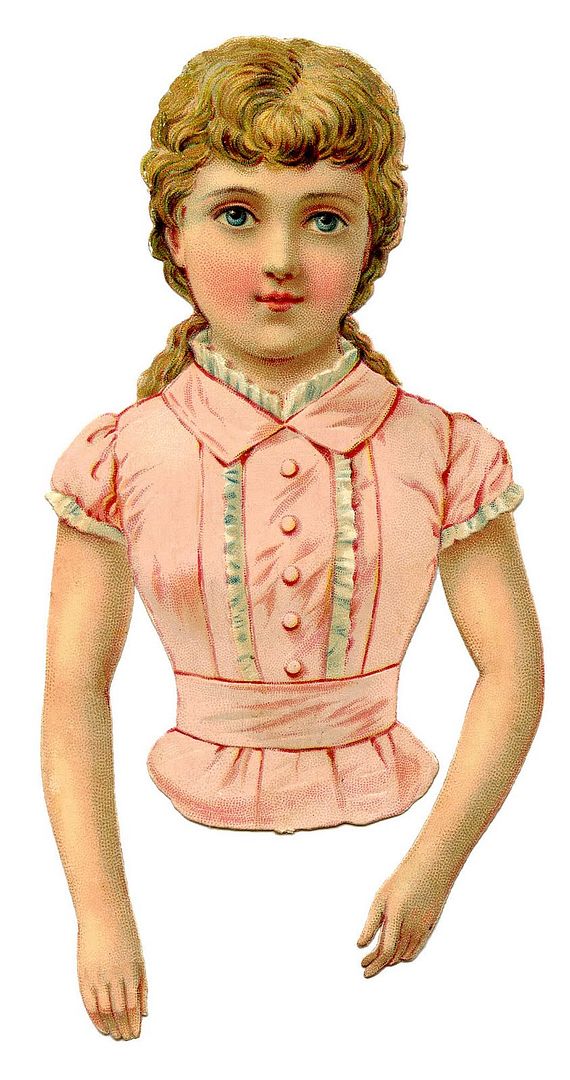
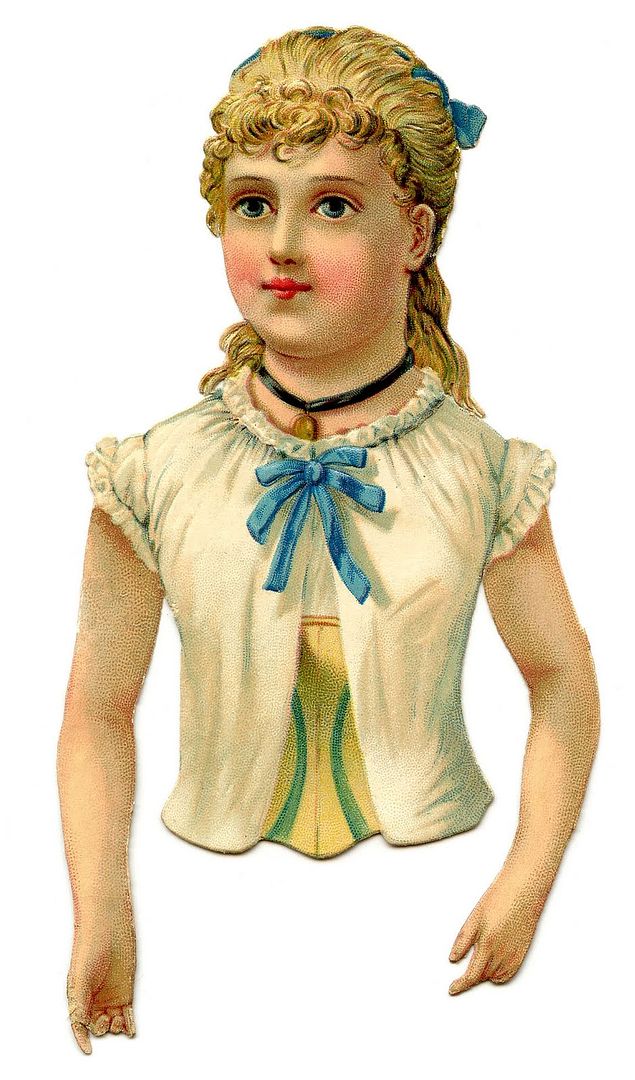
Here are some vintage Victorian scrap images for you to use in your art.  To download an image, click on the image to expand it, right-click and select Save As.


Sunday, February 13, 2011

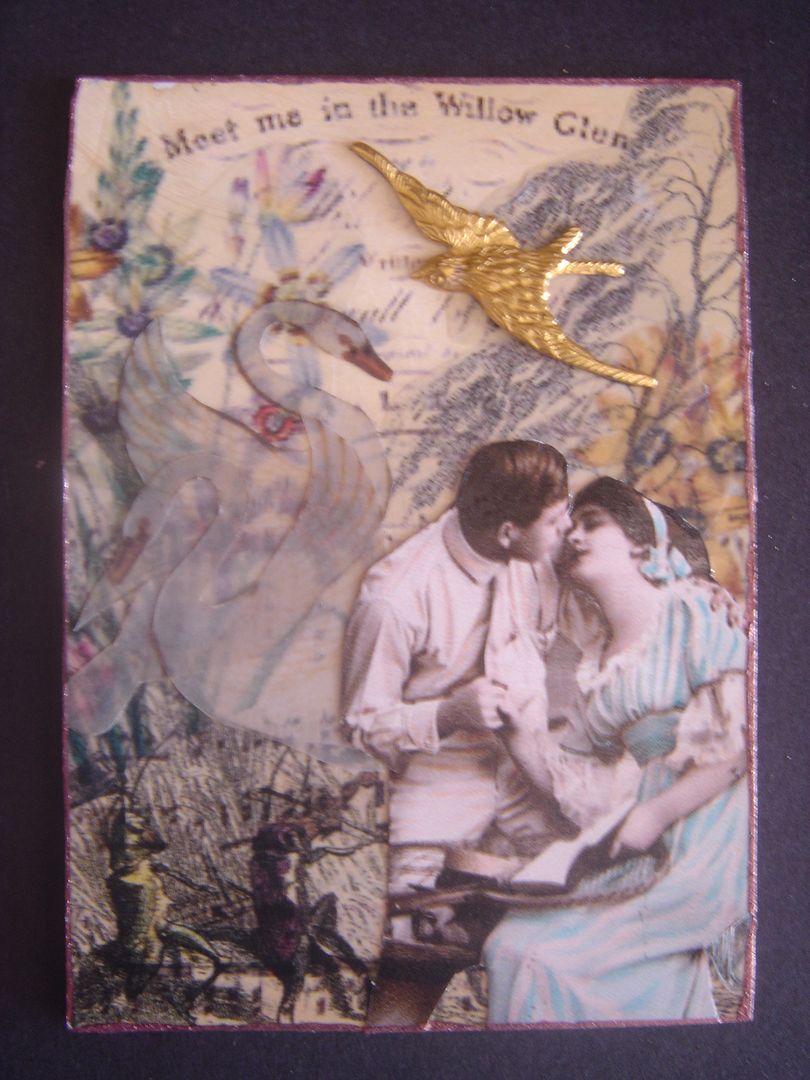
Meet Me in the Willow Glen

The flowers, trees, and crickets are all layers of rub-ons that I created using Grafix Rub-Onz Transfer Film.  To see the tutorial click here.  The swans are made of vellum.

Sunday, February 6, 2011

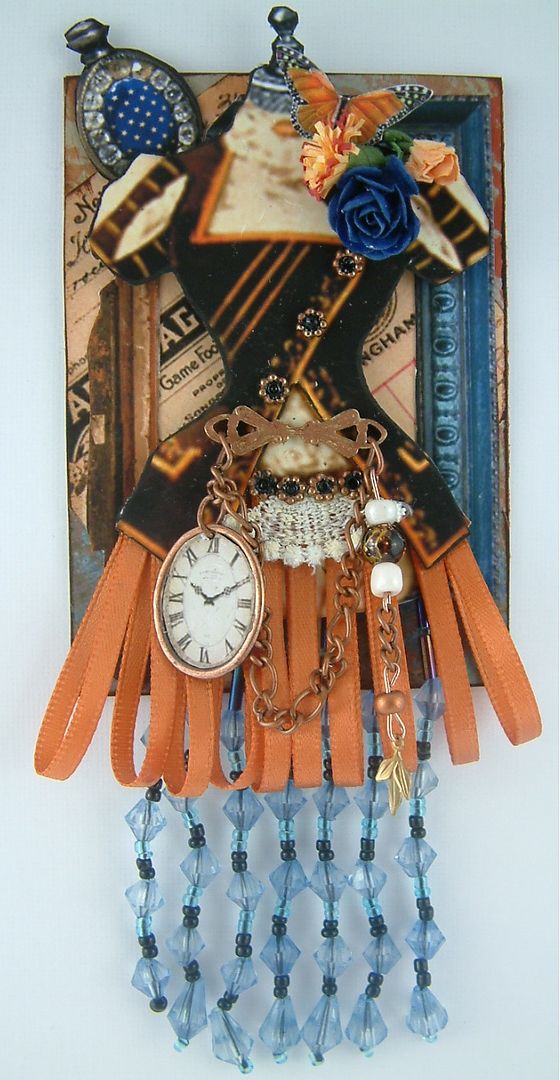
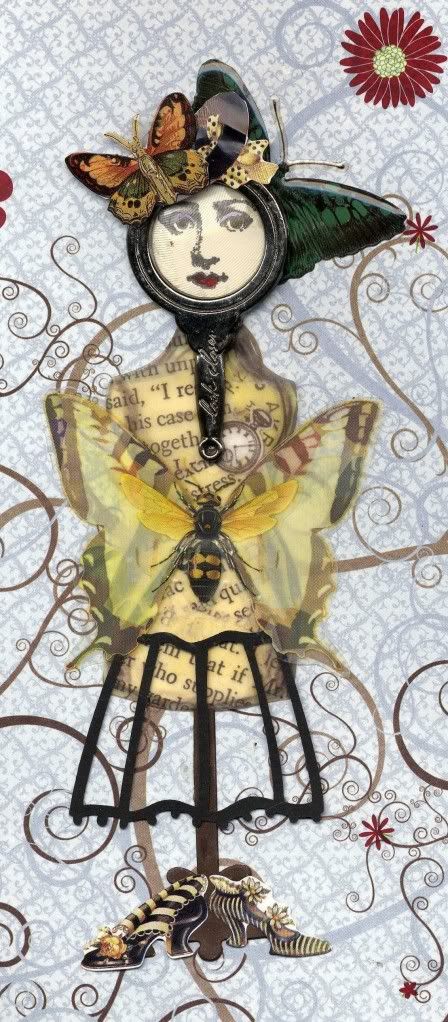
Dress Form ATC

I created this dress form for a swap in the Creative Souls group.  I had so much fun I think I’ll make some more.  Stay tuned!

Friday, February 4, 2011

Thinking Out Of the Box - ATC Fan & Tutorial

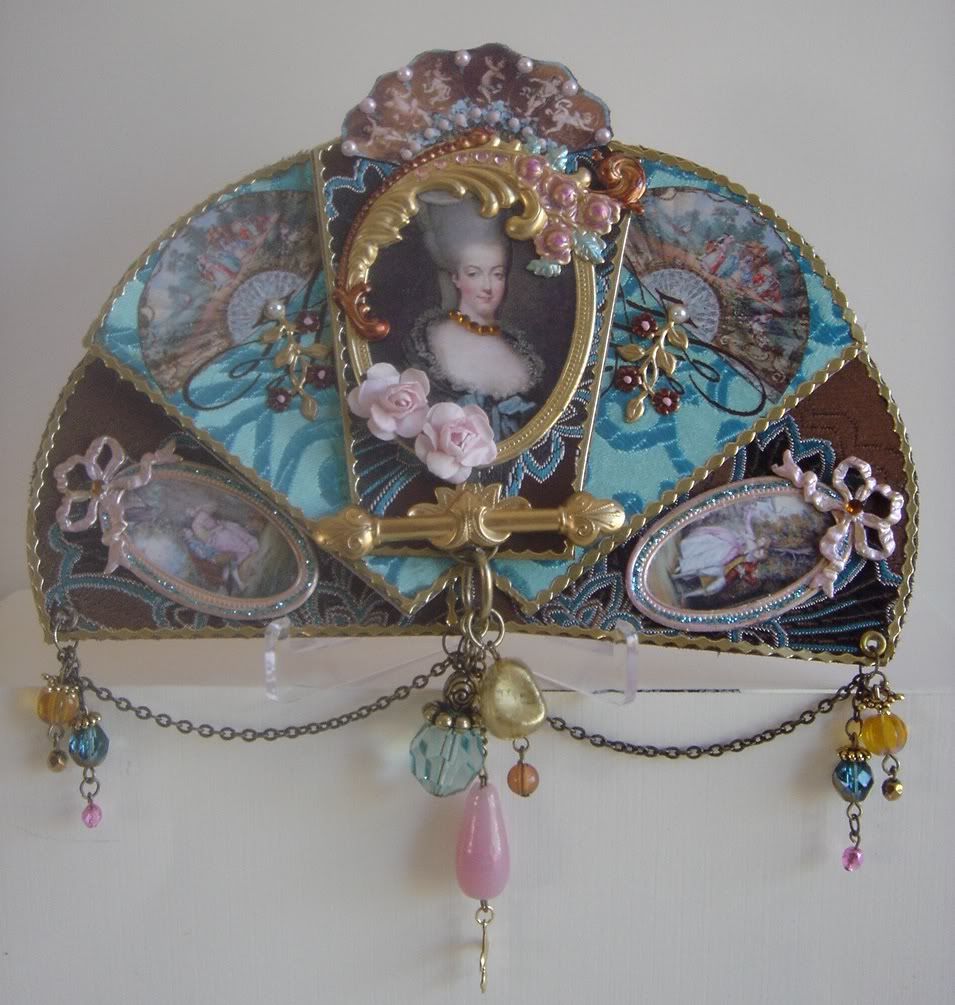
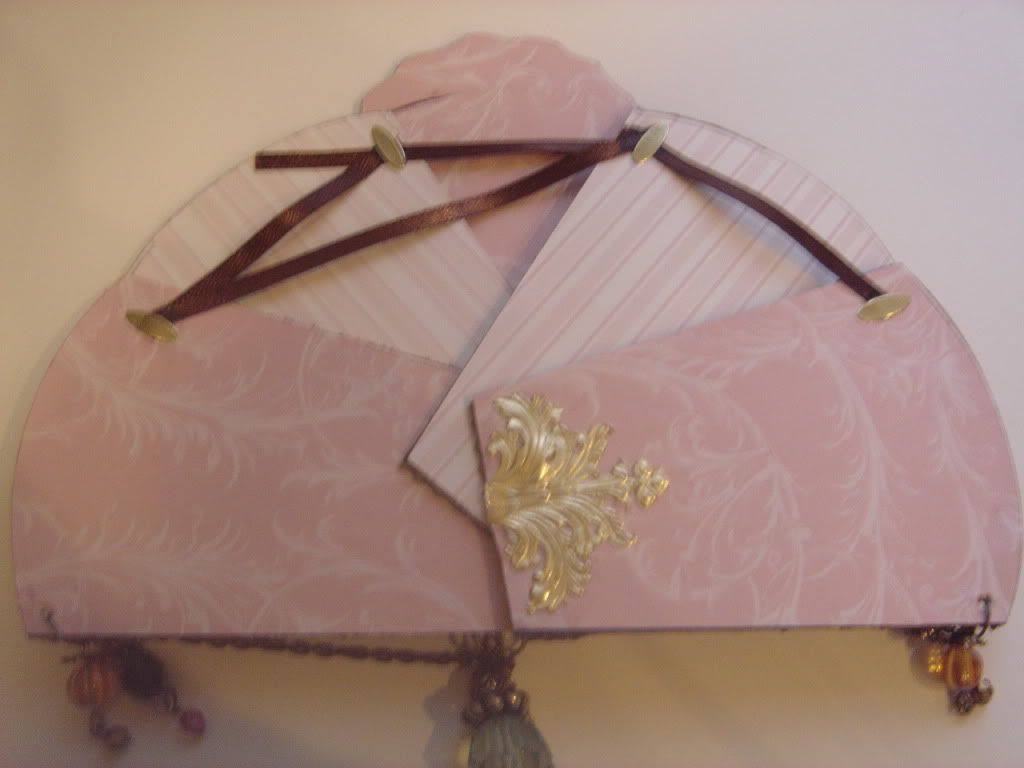
My favorite size art piece to work with is the standard ATC size.  But being a cluttered person (which I think is reflected in my art), I’m always looking for ways to cram more stuff on to the standard 2 1/2'” by 3 ½” space.  If you are familiar with my work you know that I’m always going off the edges.  I also like working with different shapes.  I love fans and use fan images frequently in my art and I enjoy making paper fans.  A while back I decided to marry the two; fans and ATCs.  The result is in the pictures below.  When the fan is closed the base dimension of a single blade is 2 ½” x 3 1/2”.  But when open, the fan expands to a five blades – lots more room for stuff! 

ATC FAN FRONT CLOSED
ATC FAN FRONT OPEN


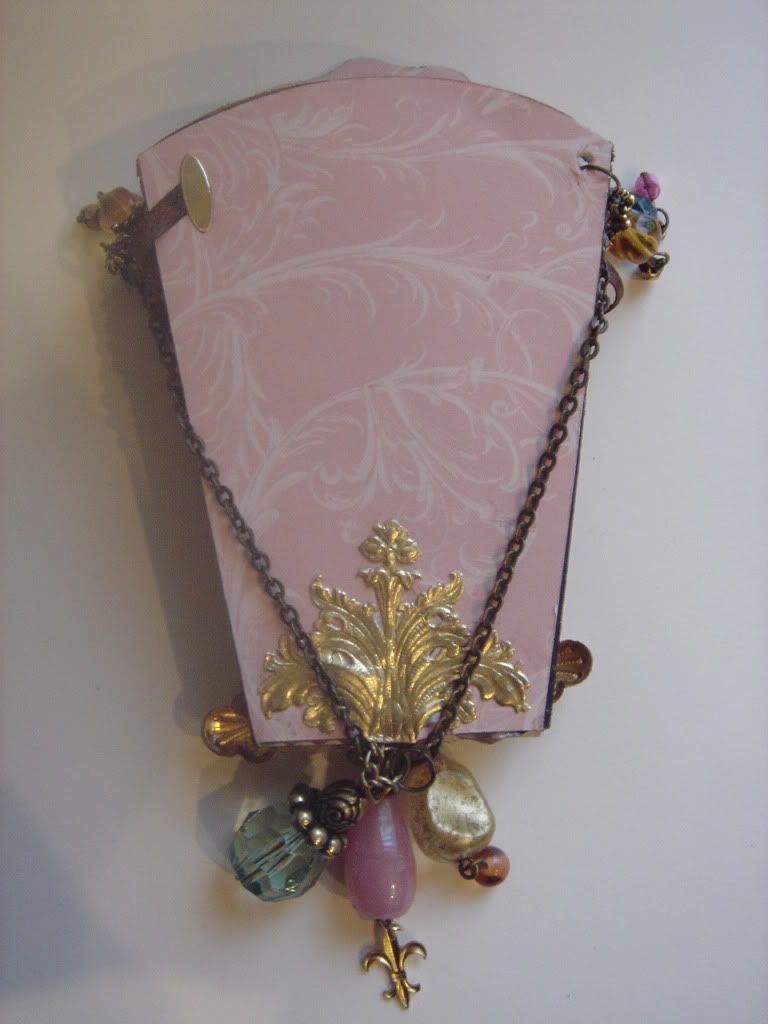
ATC FAN BACK CLOSED

A traditional fan opens from left to right with the top blade of the fan ending up on the right.  Since this is an art piece and you might want to display it open, I reengineered how the fan operates so that the top blade is always in the middle whether open or closed.  You can cover the fan blades with a variety of materials.  For the Marie fan below I choose brocade fabric for the blades.

ATC FAN BACK OPEN
Although you can’t see it as it is disguised on the front with a metal embellishment and on the back with a piece of German Scrap; there is a large brad with long prongs holding the blades together.
These fans are not the easiest things to make but if you want to give it a go, I’ve created a tutorial to guide you through making an ATC fan.  The tutorial includes step by step instructions, pictures and a blade template.  To access the tutorial click here to open a PDF file of the tutorial.  Once open, you can print the tutorial or save it on your computer.  Over a year ago I hosted a few ATC fan swaps so in future months I’ll post more pics of fans I created and fans created by other artists.
 

Monday, January 31, 2011

Cigar Box Books

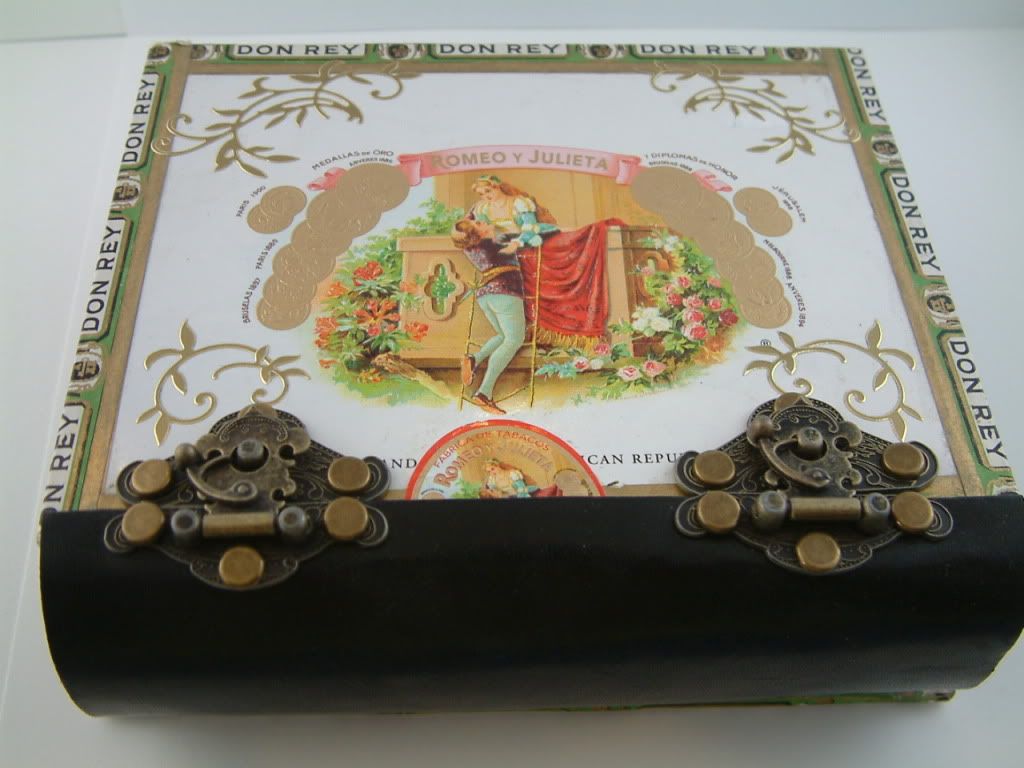
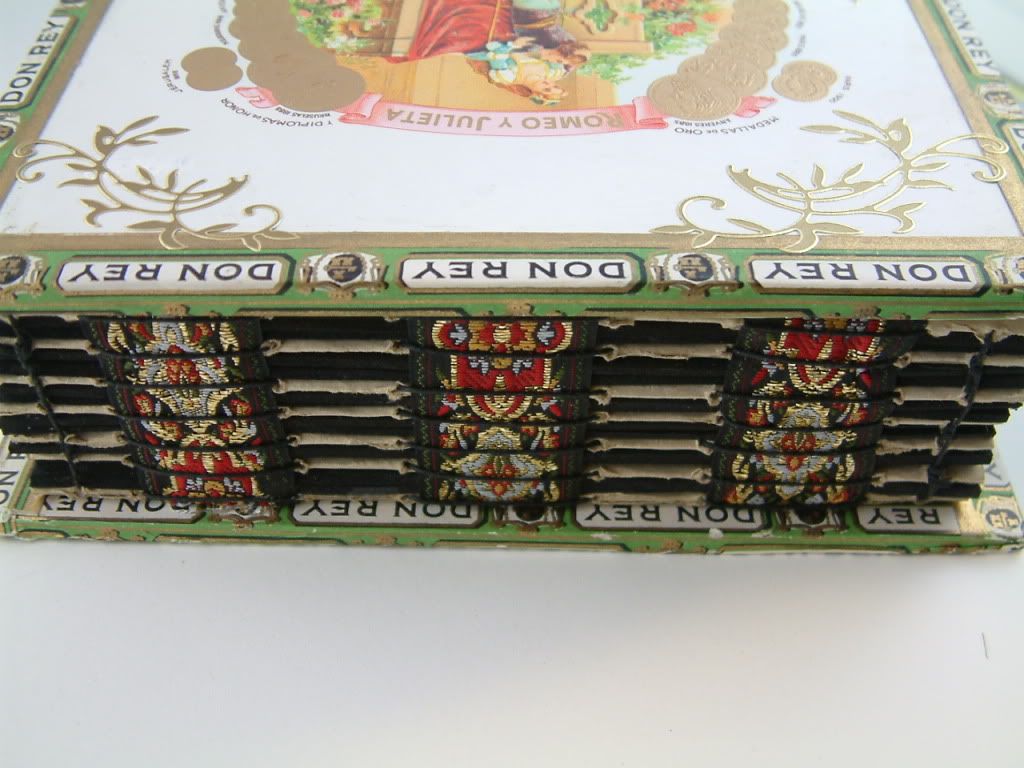
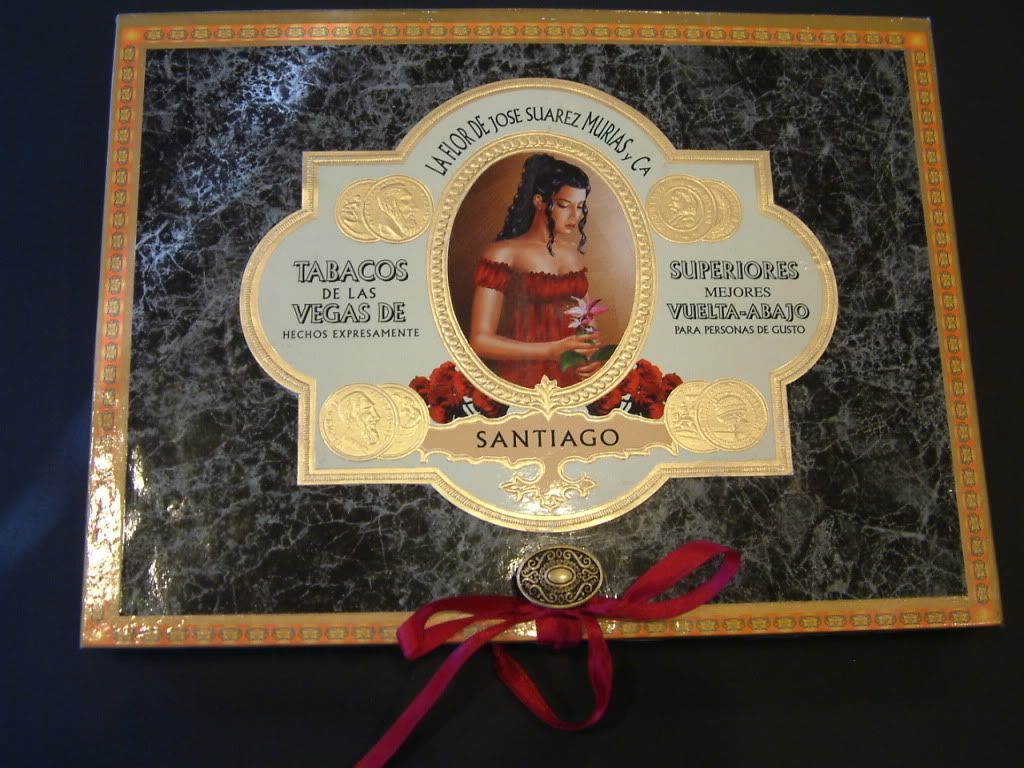
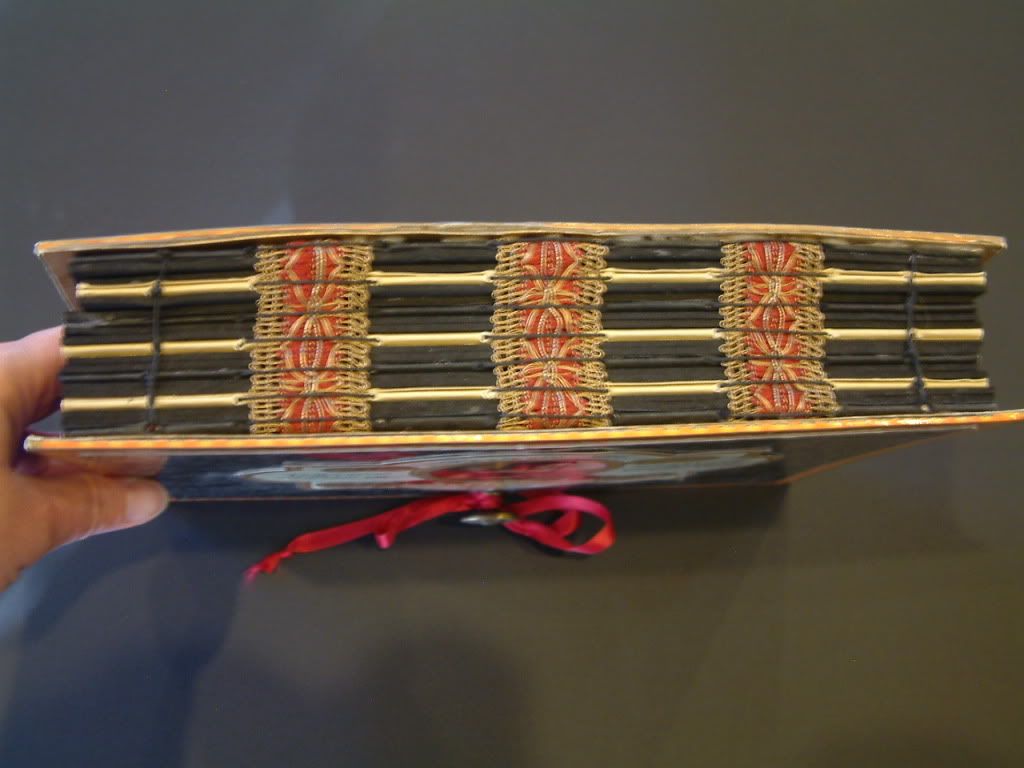
Since I’ve been posting cigar box labels and edgings that you can download and use for your art I thought I would share with you my cigar box books.  To make these books I cutoff the top and bottom of a cigar box and use them as the front and back covers of the book.  The inside pages are cardstock.  I sew the groups of pages or “signatures” together with wax linen thread.  The ribbon is woven in the spine as I sew the signatures together.  I glue the top and bottom box lids to the top and bottom sheet of cardstock.  In the pictures below you can see different closure options (knob, handle with key, and leather with latch).
If you missed the postings on the downloadable images, here are the links.

Friday, January 28, 2011

Tutorial - Creating a Stained Glass Look by Embossing Transparency Film

In November I posted a tutorial on “Creating a Stained Glass Look Using a Glass Slide”.  Embossing transparency film is another option to creating the look of stained glass although I don’t think is sparkles quite as nicely as real glass.  But with transparency film, you can print and emboss any digital image, whereas with glass, you are limited to rubber stamps.


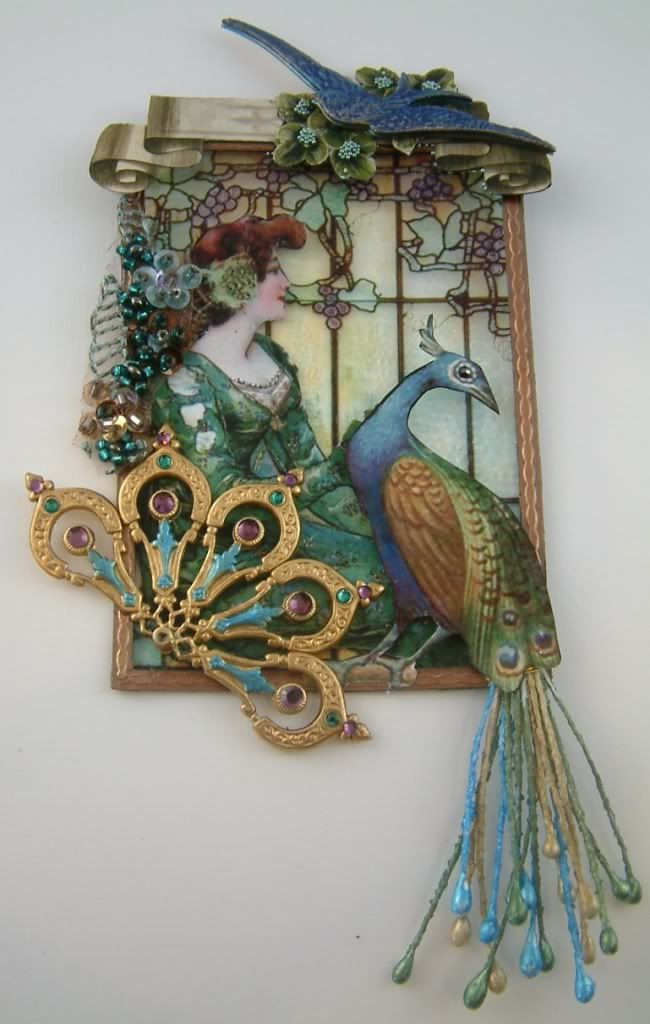
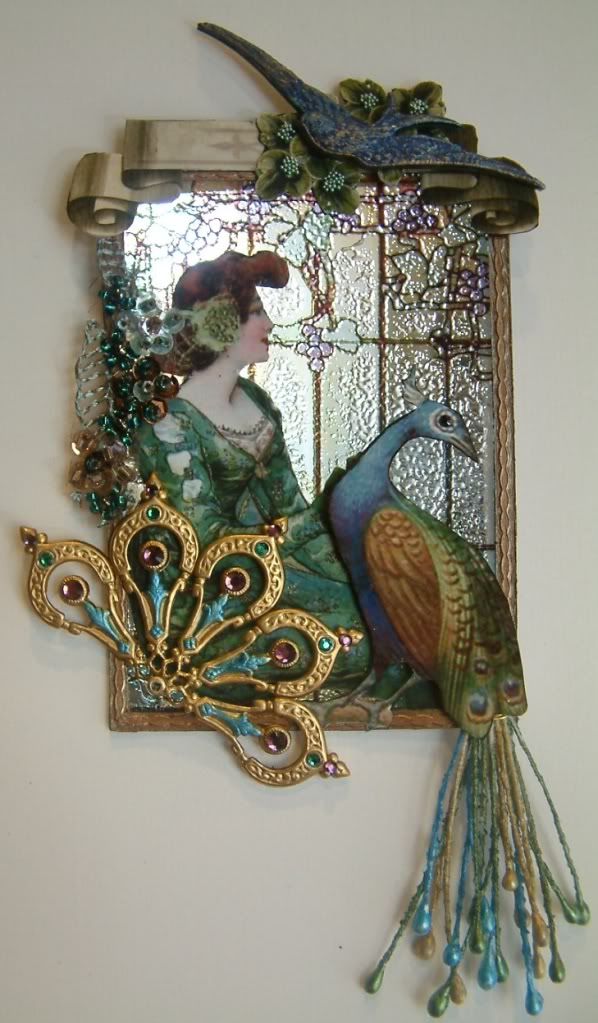
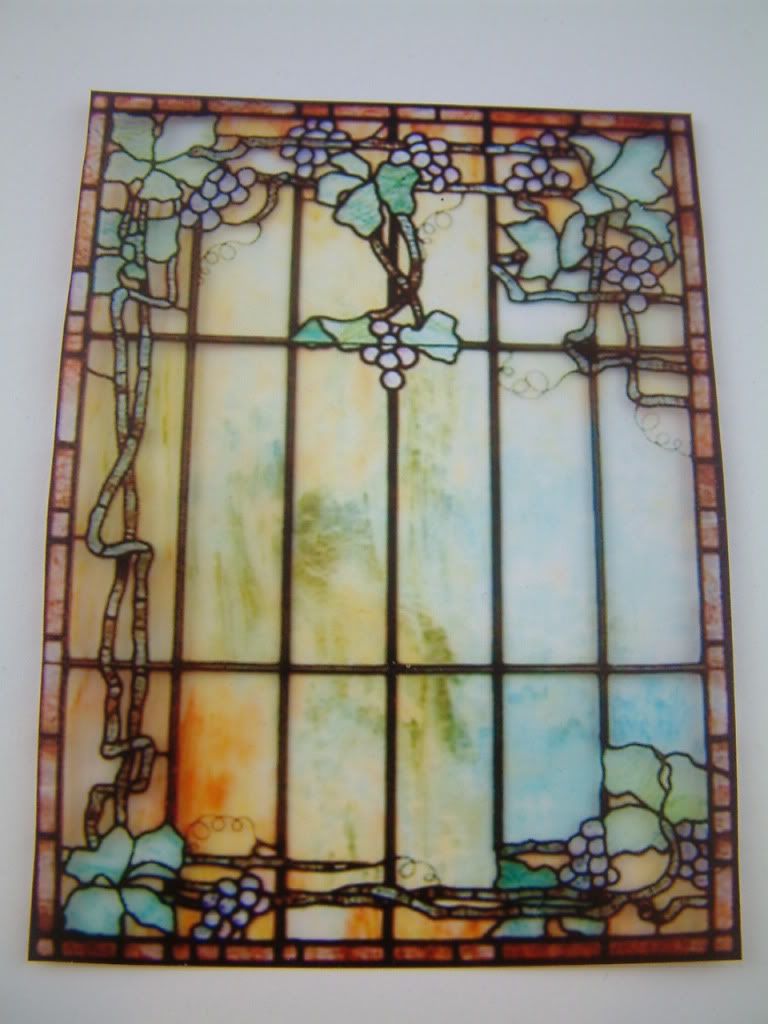
The base of the ATC below is an image of an art nouveau stained glass window that I printed on transparency film and embossed.  So that you could better see the colors on the transparency, the first image of the piece is photographed on white paper.  The second image is photographed with the light behind the piece.  Be sure to click on the image to see all the details.
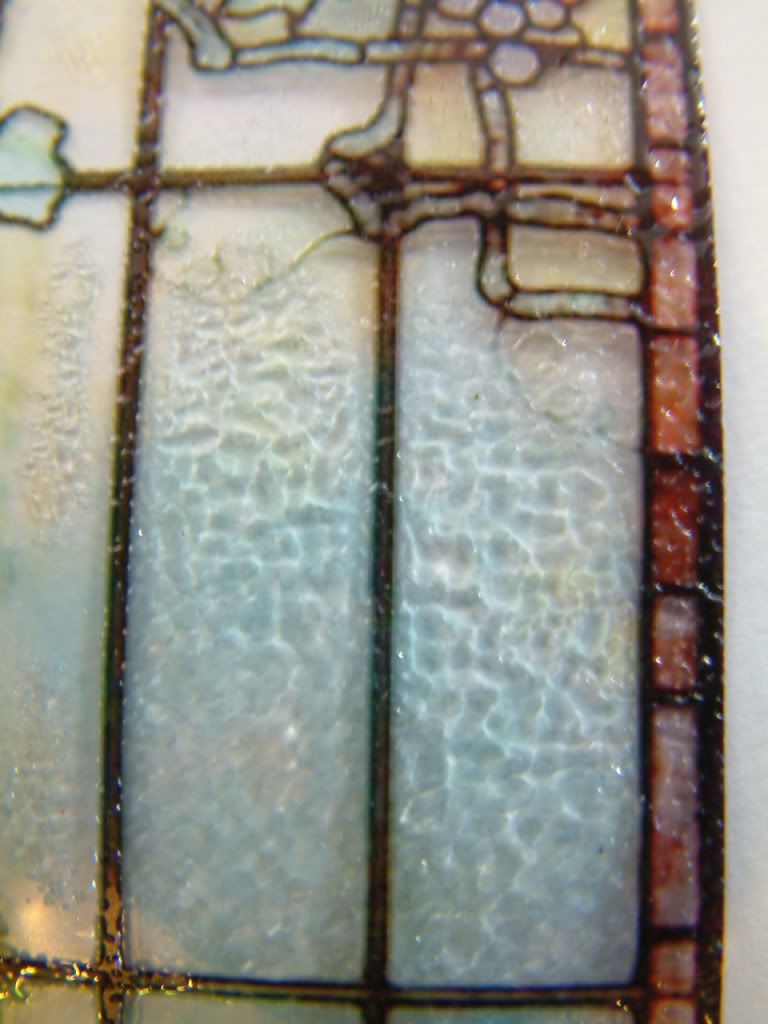
The image below shows the piece with the light behind it.  You can see the rippling effect of the embossing that looks like old stained glass.

What you will need:
  • Transparency Film for Inkjet Printers
  • Clear Embossing Powder
  • Heat Gun
Optional:
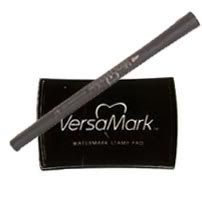
  • Versamark Stamp Pad
  • Versamarker Pen

There are two options when working with transparency film.  You can use a rubberstamp and Staz-On ink to stamp and emboss the image on the film or you can print the image on the film using an inkjet printer.  This tutorial covers printing an image.  With either method make sure the transparency film is made for use in an inkjet printer so that it will standup to the heat of the printer and the heat gun.  You can purchase transparency film at office supply stores like Office Max and Staples as well as online stores like Amazon.  The film comes in letter sized sheets (8 1/2“ x 11 ½”).

Transparency Film
You can purchase transparency film at office supply stores like Office Max and Staples as well as online stores like Amazon.  The film comes in letter sized sheets (8 1/2“ x 11 ½”).
Versamark
You can purchase Versamark stamp pads and Versamaker pins at most craft stores and online craft and scrapbooking stores.
PRINTING AND EMBOSSING YOUR IMAGE
  • Transparencies usually have a smooth side and a rough side.  Stamp or print your image on the rough side.
  • If you are printing multiple images only print on about a quarter of the transparency film at a time.  The ink needs to be wet for the embossing powder to stick.  If you print too many images, by the time everything has printed, the first images printed will be dry so the embossing powder won’t stick.  Once you have embossed your images you can cutoff the part that is used and run the unused portion through the printer again.
  • If your printer feeder doesn’t pull the transparency film, use removable double stick tape to adhere the film to a sheet of paper and try again.  Some transparency film comes with a white strip on one end to make it easy for the printer feed to grab the film.
  • Before you start to print have your embossing powder ready to sprinkle on the image the moment it comes out of the printer.  You don’t have much time before the ink dries.
  • Use a heat gun to melt the embossing powder.  Keep the gun moving and don’t over heat the transparency film or it will begin to warp.
BEFORE EMBOSSING
AFTER EMBOSSING
When you finish embossing you can go back and add paint and or ink to your piece.  I added purple alcohol ink to the grapes in the art nouveau piece as I thought they would look better darker.
OTHER OPTIONS
If your printer ink dries too quickly to get a good result:
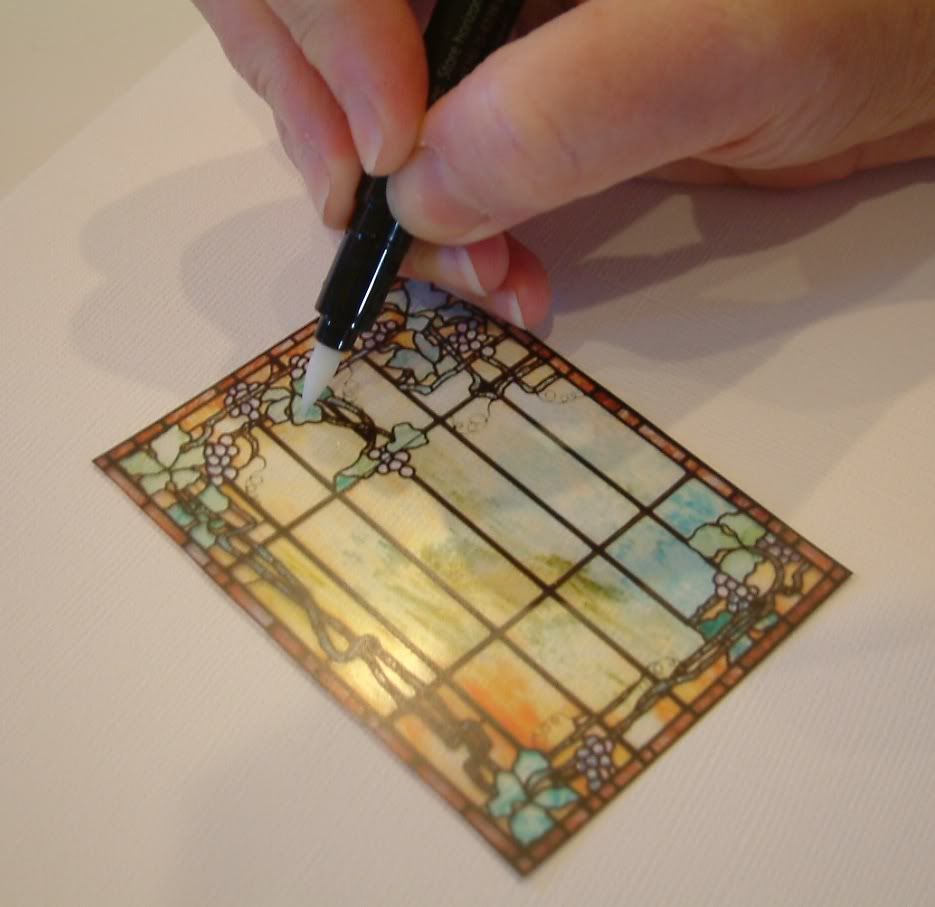
Let the image dry completely.  Use a Versamark pen to coat the desired areas.  Next, apply embossing power and heat to melt.  Versamark provides a clear tacky surface that embossing powder sticks to.
If you want to add additional embossing:
Use a Versamark pen to coat the desired areas.  Next, apply embossing power and heat to melt.
If you want to emboss the entire image:
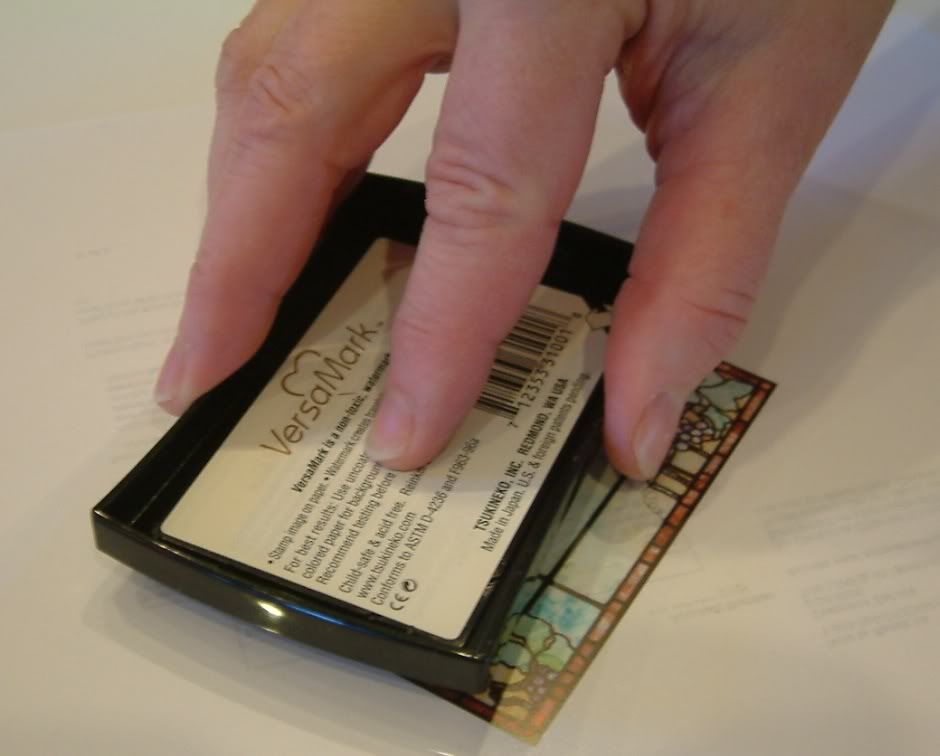
Print the image on the transparency film and wait for it to dry.  Use a Versamark stamp pad to coat the entire image.  Next apply embossing power and heat to melt.
CREATE A FRAME FOR YOUR EMBOSSED TRANSPARENCY IMAGE
To frame the image you need to sandwich the transparency film between two pieces cardstock or chipboard.  For the art nouveau piece I cut two 2 ½” x 3 1/2“ pieces out of thin chipboard (one for the front and one for the back).  I then cut a hole in the center of each piece leaving a thin border and painted the chipboard.  The size piece you cut and the hole you cut in each piece will depend on the size of your project and how much of the image you want to expose.  Make sure that you cut the embossed transparency image slightly larger than the opening so you have room to apply glue to the edges.
Chipboard Frame (make 2 pieces one for front & one for back)
Transparency Glued Between Two Pieces of Chipboard

You are finished and ready to add images and embellishments.  The images and embellishmentsl add stability to the piece.
PRINTING THE IMAGE WITHOUT EMBOSSING
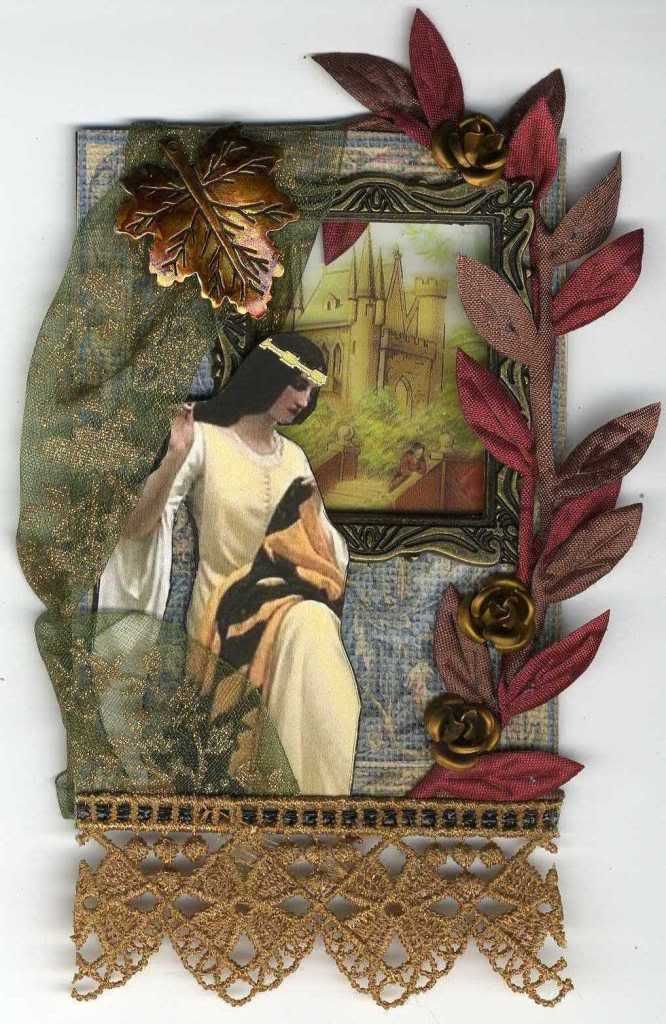
If you are looking for more of a matte finish, don’t emboss the transparency.  Below is an ATC titled “The Lady of Shalott”.  In the poem by Alfred Lord Tennyson, the lady of Shalott sits by a window and weaves.  She is cursed and cannot look out of the window at the view of Camelot or she will die.  I wanted to create the effect of a window so I printed the picture of the castle on transparency film but did not emboss the image.

Click here to download PDF file of this tutorial.

Tuesday, January 25, 2011

Butterfly Art Doll

Friday, January 21, 2011

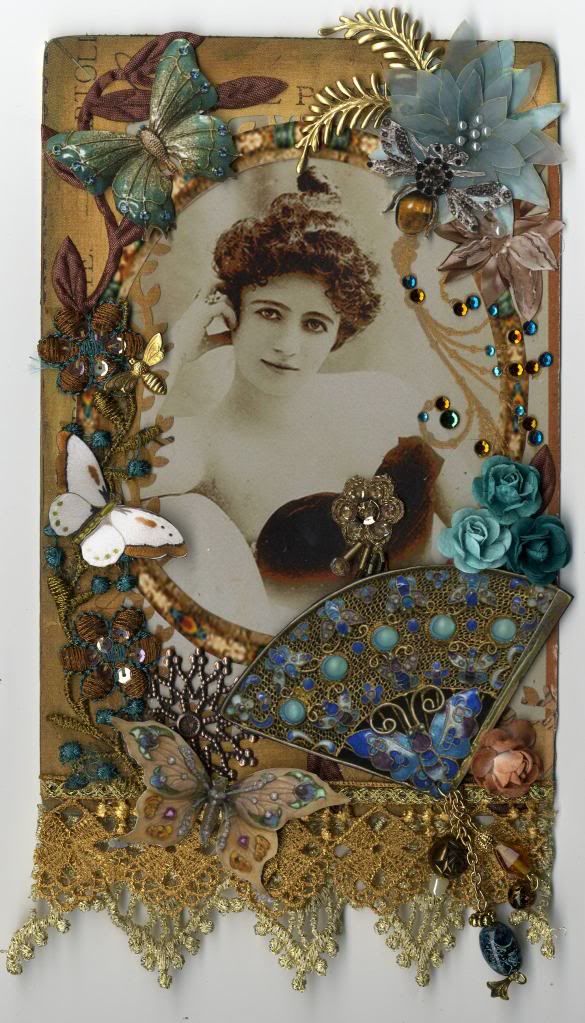
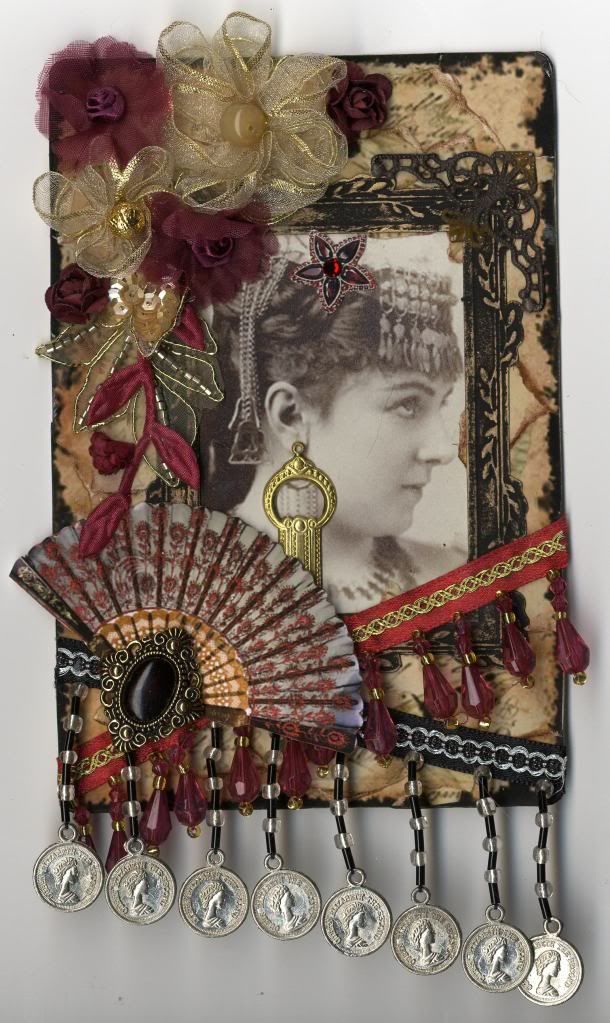
Le Courtesan - Altered Cabinet Card

I made the turquoise flower in the upper right corner by first printing the flower on white presentation paper then printing the image in three smaller sizes on vellum.  I glued all the pieces together and added pearls.  The butterflies, bee and fan are all images of jewelry.

If you aren't familar with cabinet cards they were the style of photograph which was universally adopted for photographic portraiture in 1870. It consisted of a thin photograph that was generally mounted on cards measuring 4¼ by 6½ inches.

Wednesday, January 19, 2011

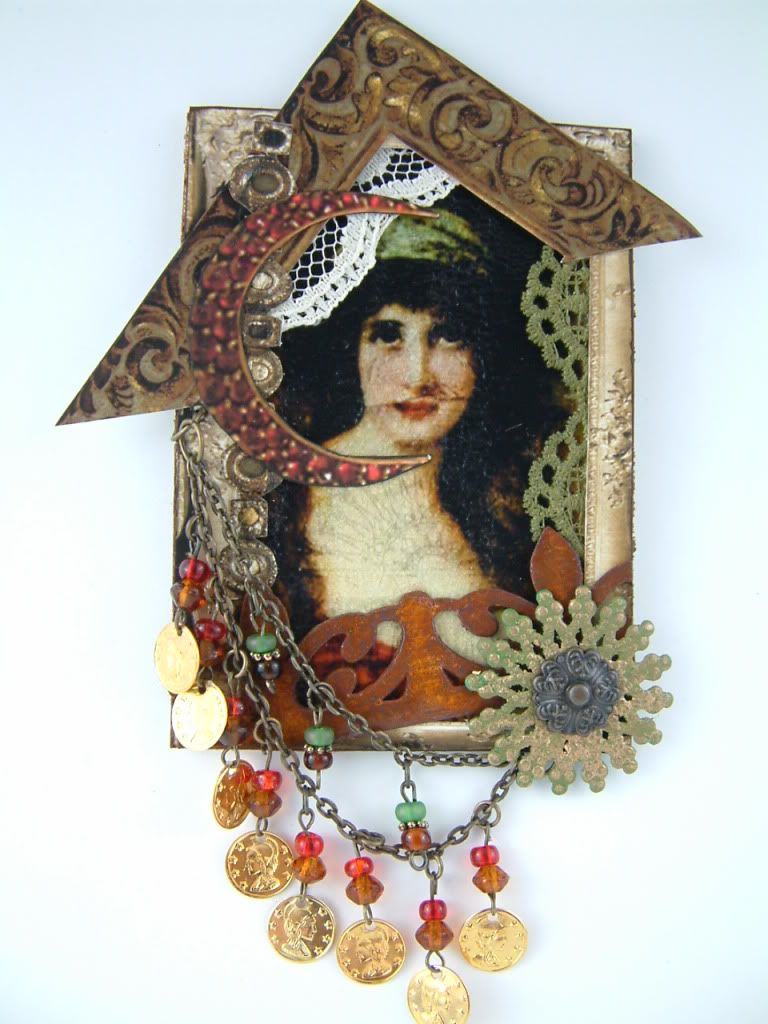
Gypsy Altered Cabinet Card

Tuesday, January 18, 2011

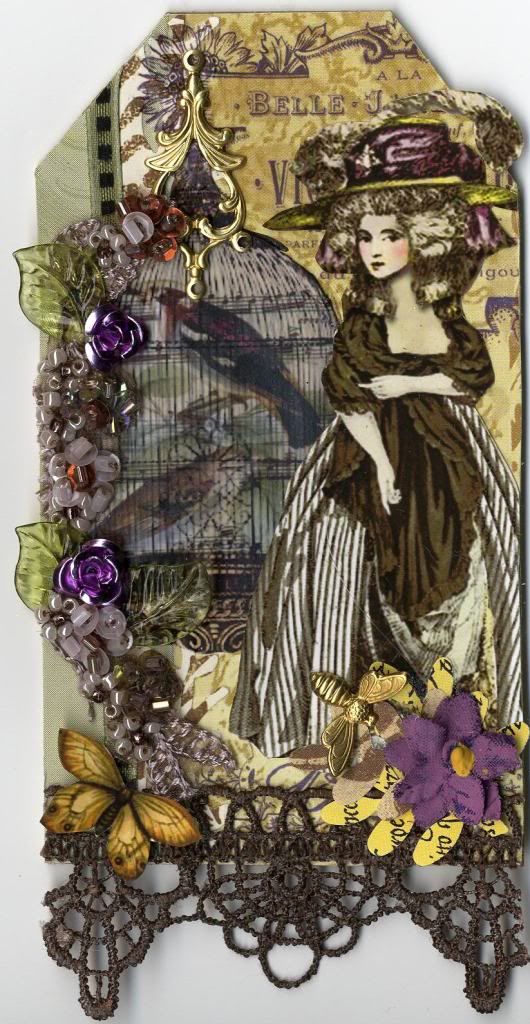
Marie Antoinette Tag

The birdcage on this tag is a rub-on I created using Grafix Rub-Onz.  Click here for the tutorial.

Gypsy ATC

For the image in this ATC I used the crackle technique described in the Tutorial – Aging and Crackling an Image.

Monday, January 17, 2011

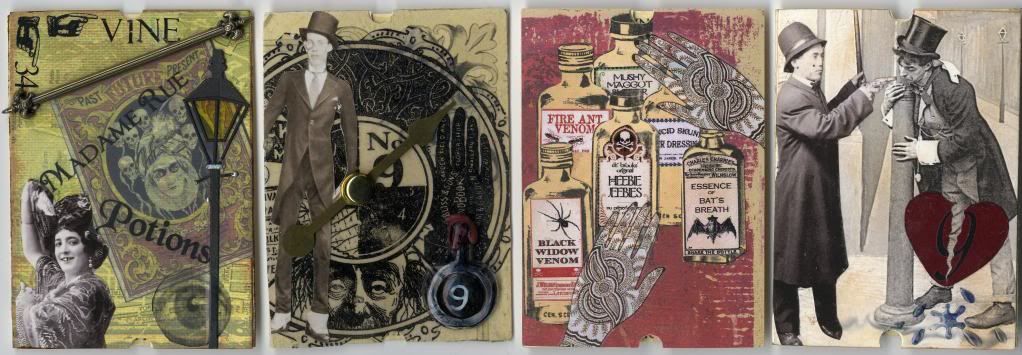
Love Potion #9 ATCs - Song Swap

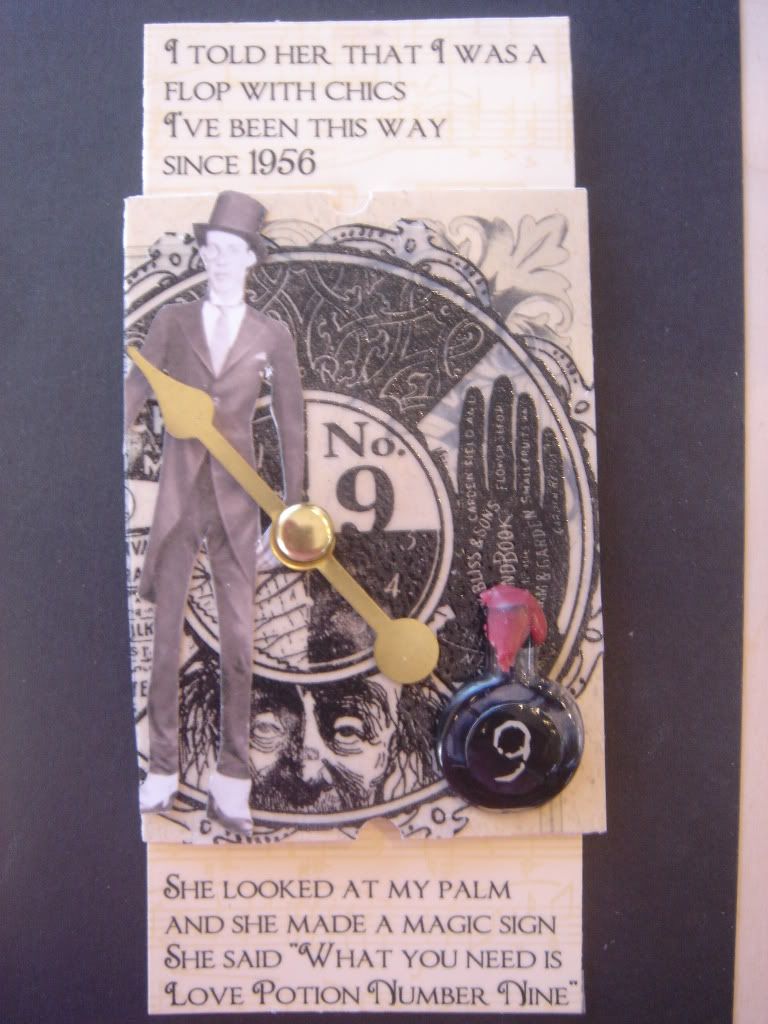
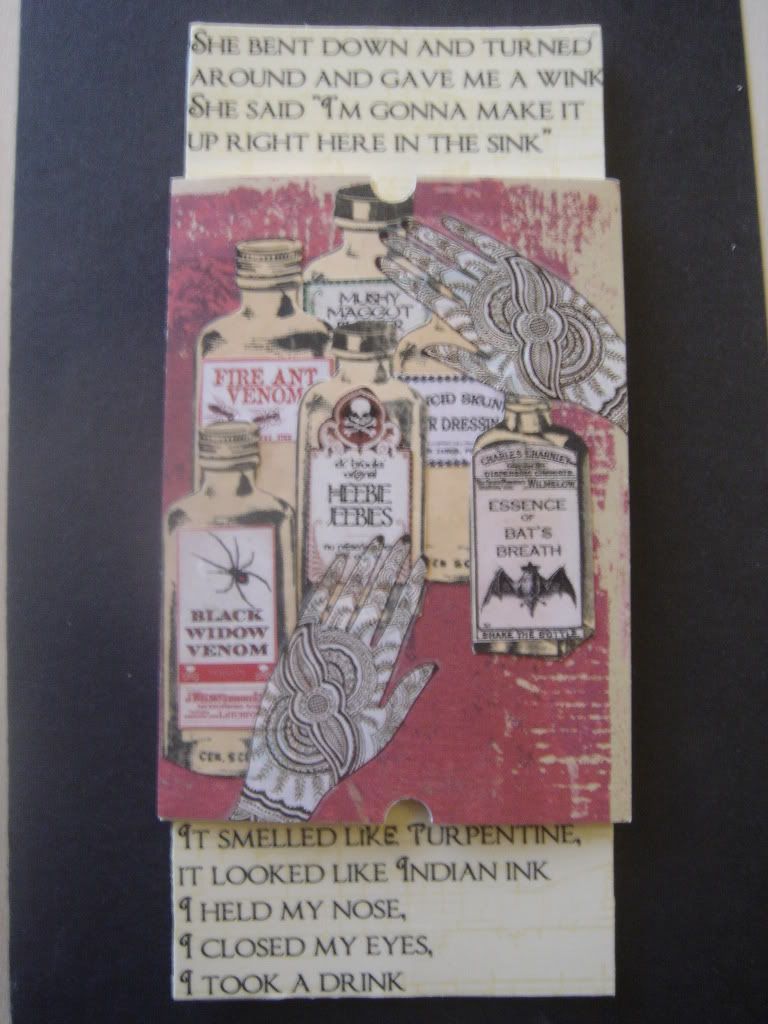
This set of 4 ATCs was created for a song swap.  The premise of the swap is that you choose a song and illustrate it in four cards.  I found the first challenge to be choosing a song.  It turned out to be a difficult task to find a song that could be neatly illustrated in four cards.  In addition the lyrics must also be included on the card.  I finally chose Love Potion #9, which has been a favorite of mine since I was a kid.  At the bottom and top of each card is a niche that when pulled expands the card to reveal the lyrics.  In the third card the bottle contains real ink and is sealed with wax.


Friday, January 14, 2011

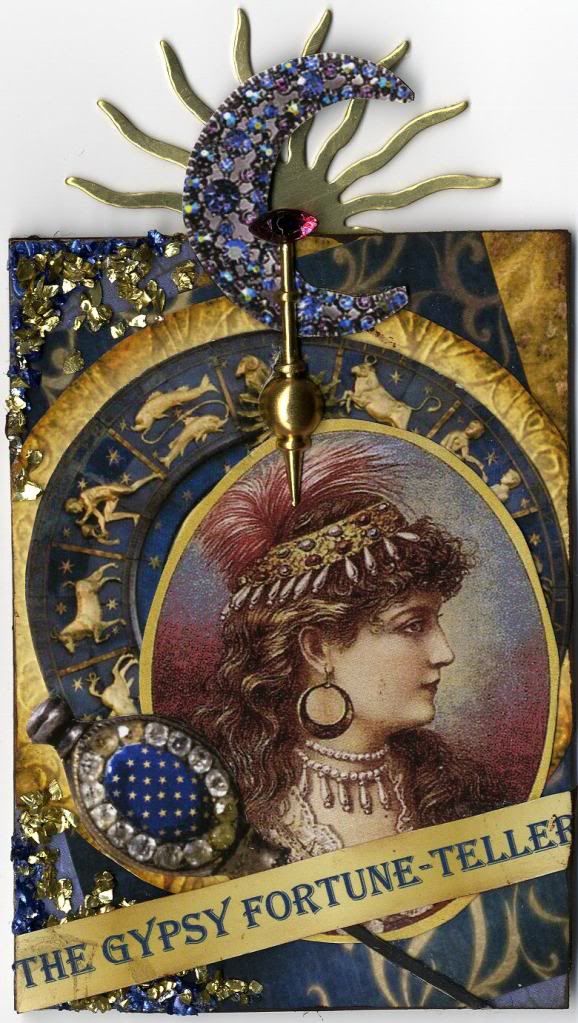
The Gypsy Fortune Teller ATC

Organizational Tip - Using Thimble Display Cases as Storage Trays

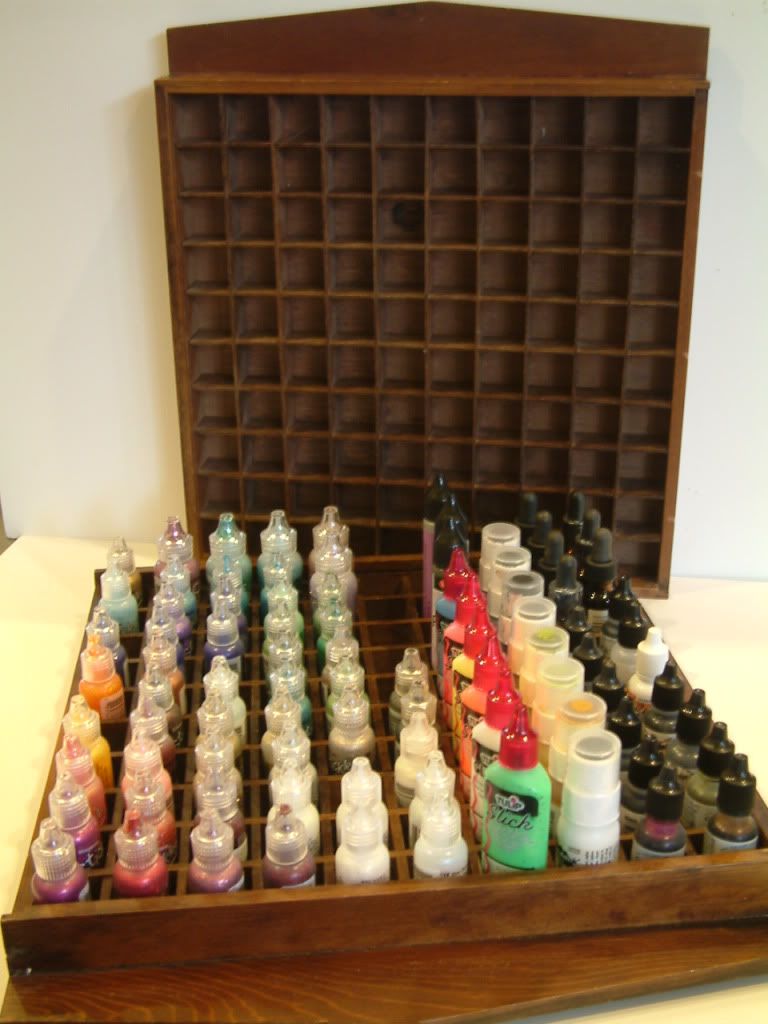
To store small containers I use thimble display cases.  Laid flat they become a storage tray.  They work great as you can see the color of the container and it’s easy to take the tray where ever your project is.  I purchased my trays on Ebay.  The newer cases are expensive but older inexpensive ones pop-up regularly.  My trays have 100 slots and measure approximately 15 ½” x 14”. 
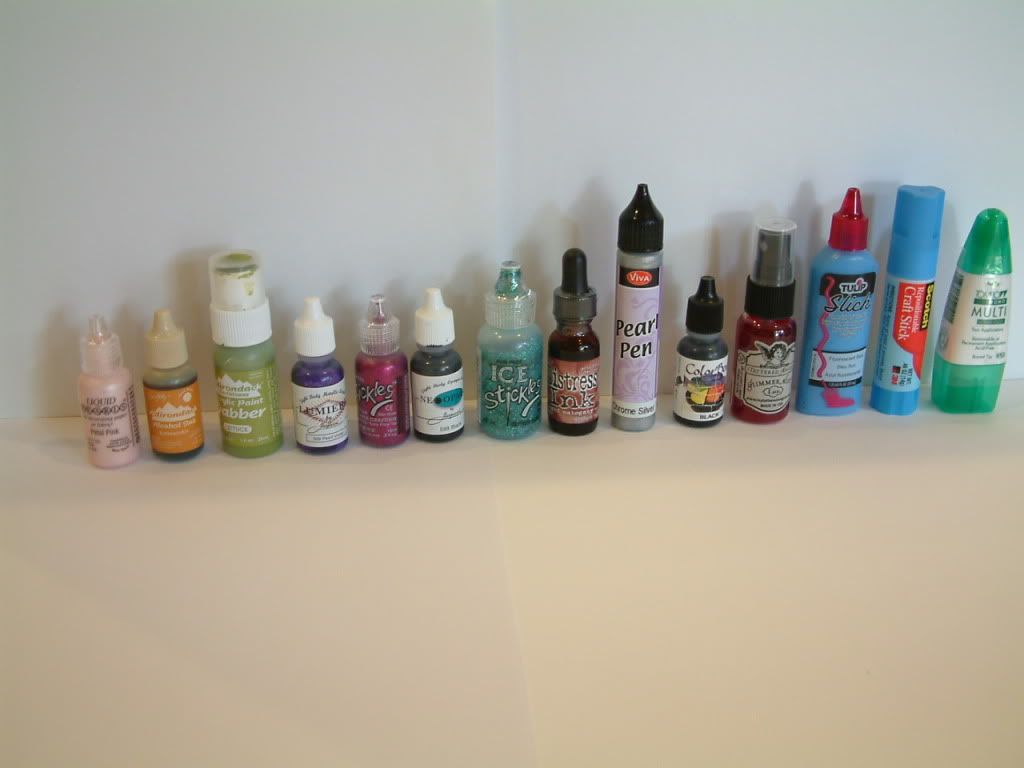
Some of the products you can store are:
  • Ranger Alcohol Inks
  • Ranger Stickles (large and small containers)
  • Viva Pearl Pens
  • Lumiere Paints
  • Liquid Pearls Paint
  • Neo Opaque Paint
  • Adirondack Paint Dabber
  • Tulip Slick Paint
  • Glimmer Mist
  • Stamp Pad Re-inkers (Staz-On, Color Box, Distress Inc. etc.)
  • Some Glue Containers (Tombo Multi, Glue Sticks, etc.)

    Wednesday, January 12, 2011

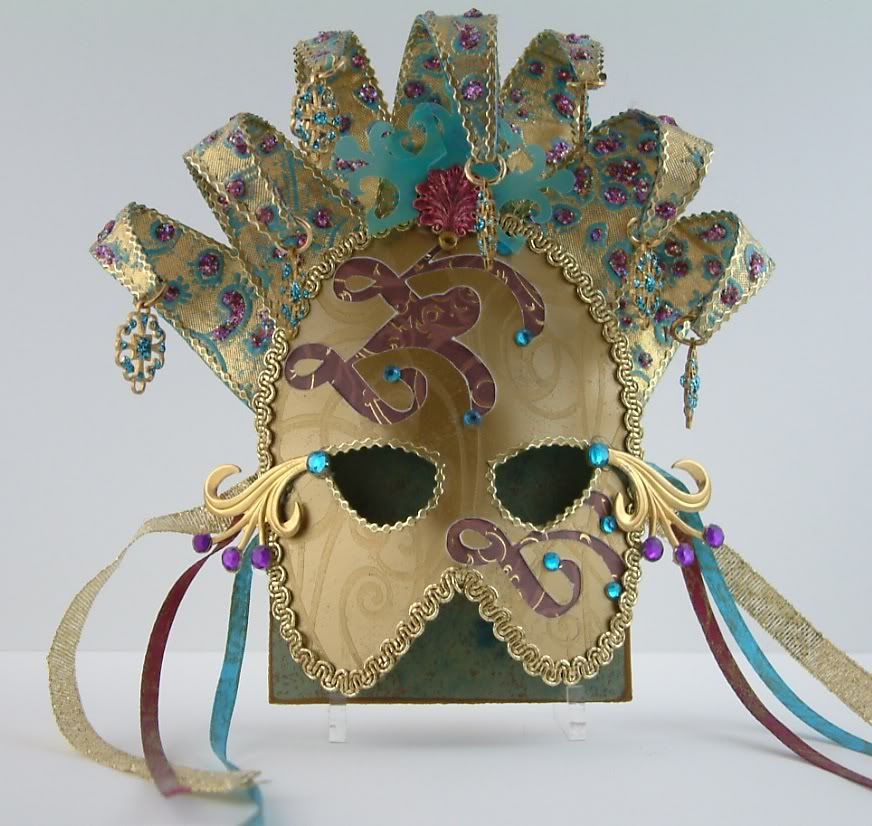
    Venetian Mask ATC

    The base of this three dimensional mask is the standard ATC size of 2 1/2" x 3 1/2".   
    I embedded wire in the decorative triangles at the top so that they would hold their shape.

    Thursday, January 6, 2011

    Dress Form

    I made this dress form for a swap in the Marie Antoinette Mail Art Group.

    Wednesday, January 5, 2011

    Three Muses Challenge - Old Fashioned

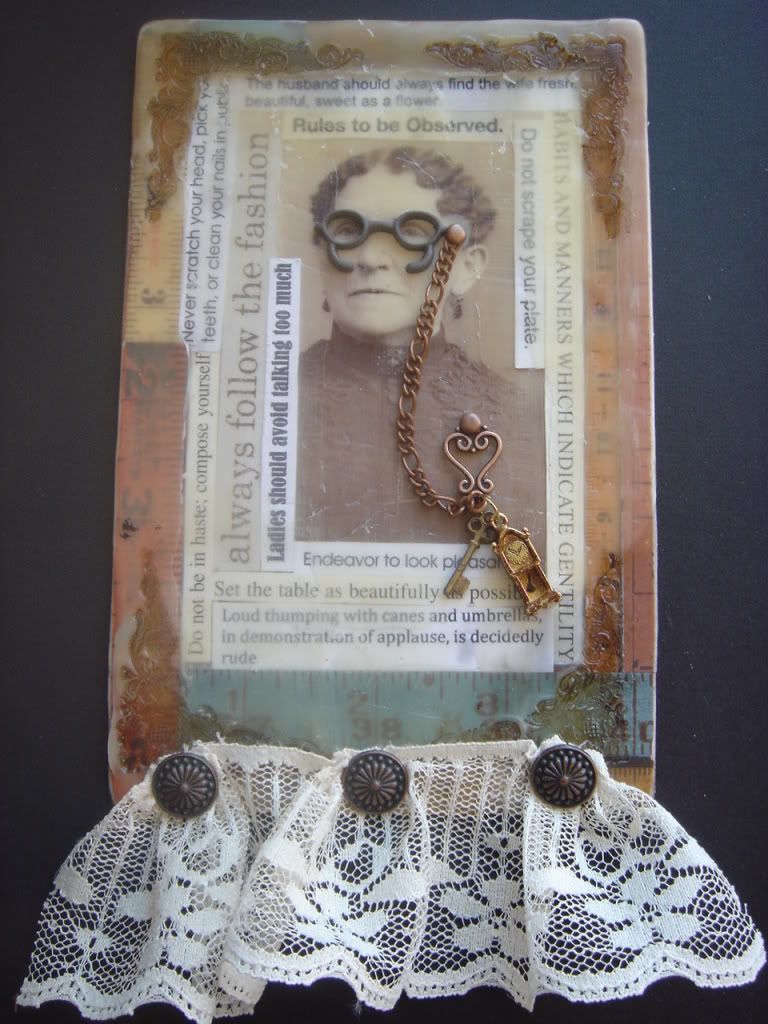
    The Three Muses Challenge this week is “Old Fashioned”.  My entry is an altered cabinet card titled “Miss Prim”.  She of course has all kinds of rules that a woman must follow.

    • Do not scrape your plate
    • Set the table as beautifully as possible
    • The husband should always find the wife fresh, beautiful, sweet as a flower
    • Never scratch your head, pick your teeth, or clean your nails in public
    • Do not be in haste; compose yourself
    • Loud thumping with canes and umbrellas, in demonstration of applause is decidedly rude.
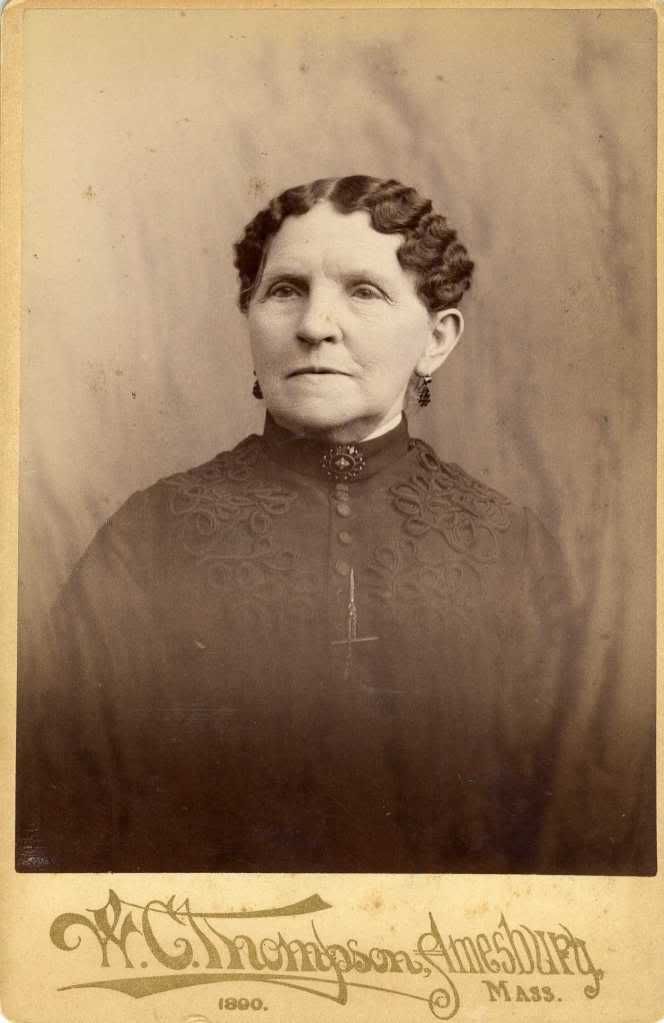
     The card is coated with wax.  I pressed a stamp in the corners while the wax was hot and added alcohol ink to give it more dimension.  Below is the card before altering.